Most mattress shopping conversations collapse into three words: soft, medium, firm. Those words travel badly. One brand's medium is another brand's brick, and the label printed on the box tells you nothing about whether your spine stays neutral at three in the morning. If you are shopping for a mattress for back pain relief, the useful question is not how a bed feels during a five-minute showroom sit. It is what that bed does to your alignment across eight hours, night after night, for the next seven years.
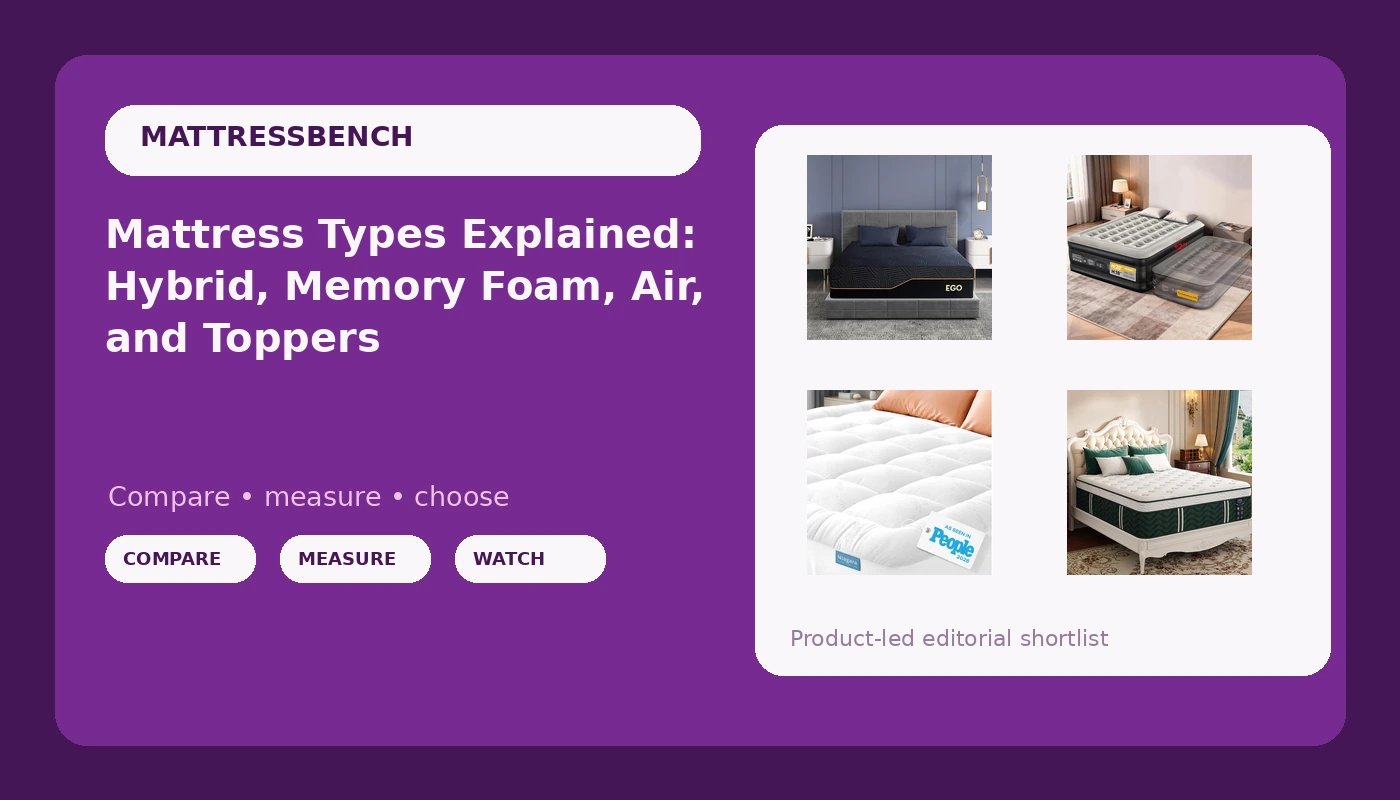
The four products below are not variations on one theme. They are four different answers to four different problems: a memory foam king built around back support, a hybrid shipped in a box in a compact size, an ultra soft topper meant to change a mattress you already own, and a raised air bed for the nights when the guest room has to become a bedroom. Understanding which problem you actually have is most of the decision.
Related: How to Test a Mattress Before the Return Window Closes →
Quick answer
There is no single mattress type that suits every back. Support comes from how a bed holds your spine, and that depends on your sleep position, your body weight, and how long you plan to sleep on it. Memory foam contours and relieves pressure, hybrids pair coil support with a foam comfort layer, a topper changes the surface feel of a mattress you already own, and an air bed is a temporary solution rather than a seven-year daily driver. Pick the construction that matches the job, then judge firmness with your own body instead of the label.
Four useful options
| Model | Best fit | What stands out |
|---|---|---|
| EGOHOME King 14 inch Memory Foam Mattress for Back Pain Relief Medium Firm | Sleepers who want contouring pressure relief in a king | 14 inch all-foam build with a medium firm target feel |
| (Hotel-Level) Luxury 10 Inch Twin XL Size Hybrid Bed Mattress in a box | Smaller rooms, adjustable bases, guest and dorm setups | Hybrid coil and foam construction in a compact Twin XL |
| Niagara Sleep Solution Full Ultra Soft Mattress Topper, Back Pain Relief | Changing the feel of a mattress you already own | Full-size topper designed to soften a firm sleeping surface |
| OhGeni 20" Raised Queen Air Mattress (1 Pack) with Built in Pump, Airbed | Guests and short-term sleeping | 20 inch raised queen with a built-in pump |
The memory foam anchor: EGOHOME King 14 inch Memory Foam Mattress for Back Pain Relief Medium Firm
Memory foam earns its reputation for pressure relief because it deforms around the body instead of pushing back uniformly. That is genuinely useful for side sleepers, whose hips and shoulders concentrate load, and for back sleepers who need the lumbar curve filled rather than bridged. The trade-offs are equally real. Foam runs warmer than coils because air does not move through it the way it moves through an open coil unit, and a foam edge does not hold you the way a coil edge does. If you sit on the side of your bed to put on shoes, test that edge deliberately.
The phrase "medium firm" deserves scrutiny. It is a marketing range, not a measurement, and every manufacturer draws it differently. A medium firm from one brand can land firmer than another brand's firm. That is why the specification worth asking about is foam density, the weight of foam per cubic foot, because density is what determines whether the surface still supports you in year five or develops a body-shaped depression in year two. A 14 inch profile leaves room for a thicker comfort layer, which usually means more sink before you reach the support core, so heavier sleepers should weigh that against their preference.
The compact hybrid: (Hotel-Level) Luxury 10 Inch Twin XL Size Hybrid Bed Mattress in a box
Hybrids exist because coils and foam solve different halves of the same problem. The coil unit carries weight, keeps the surface from bottoming out, and lets air move, while the foam layers above it soften the contact points. For a back sleeper who finds pure foam too dead and a traditional innerspring too hard, that middle ground is often where the answer sits. Coil quality varies enormously, so the questions that matter are coil count, gauge, and whether the edge is reinforced.
Twin XL is a size worth understanding before you buy. At roughly 38 by 80 inches, it is as long as a standard king but only as wide as a twin, which makes it the standard choice for adjustable bases, dorm rooms, bunk-adjacent guest spaces, and narrow primary bedrooms where a queen will not fit. The narrow width also means motion transfer is a smaller concern, since there is no partner to disturb. Mattresses in a box arrive compressed and roll out over hours to a few days, and the expansion period matters: sleeping on one before it has fully recovered can leave impressions that never come out. Give it the full window the manufacturer specifies before you judge it.
The surface fix: Niagara Sleep Solution Full Ultra Soft Mattress Topper, Back Pain Relief
A topper is the cheapest way to change how a bed feels, and also the most misunderstood product in the category. It can add pressure relief to a surface that is too firm. It can buy you a year on a mattress that is merely uncomfortable rather than broken. What it cannot do is fix a mattress that has already failed. If your current bed has a visible sag, a soft spot where you sleep, or a foundation that flexes, a topper will follow that sag rather than correct it, and you will spend money to make the problem feel slightly better for a few months.
The honest test for whether a topper is the right purchase is simple. Press down where you sleep. If the mattress springs back evenly and the surface is merely too hard, a topper is a reasonable move. If you feel a depression that stays, the support core is done and no comfort layer on top will restore it. Also think about thickness and density: a very soft topper changes the feel quickly, but a thick one can soften the support you were relying on, which is the opposite of what a bad back needs. A topper should add comfort without removing the underlying alignment.
The temporary option: OhGeni 20" Raised Queen Air Mattress (1 Pack) with Built in Pump, Airbed
Air beds have one genuine advantage over every other option here: you control the firmness with the pump. Inflate it hard and the surface becomes very firm and quite supportive. Let air out and it softens. That adjustability is useful for a guest whose preferences you do not know, and the raised height makes a real difference for anyone who struggles to get up from floor level. A 20 inch height puts the sleeping surface close to a standard bed, which is easier on knees and backs than a low air mattress on the floor.
What an air bed is not is a long-term mattress. Vinyl stretches, seams fatigue, and a bed that holds pressure well in month one can lose it overnight by month twelve. Air also transfers motion efficiently, so a couple sharing one will feel every turn. Use it for guests, for travel, for a temporary move, or for the weeks between mattresses. If you are sleeping on an air bed every night because your back hurts and you have not decided what to buy, that decision is the thing to solve, not the pump.
Prices and availability may change. Product images, names, and retailer links are matched to verified listings. No current price, rating, stock status, or measured result is stated here without current evidence.
What support actually means for a bad back
In eighteen years of practice, the most common mattress mistake I see is not "too soft" or "too firm." It is a bed that no longer holds a neutral spine. Support and pressure relief are two different jobs, and most shoppers conflate them. Pressure relief is about spreading load so no single point gets punished. Support is about keeping the spine in the same shape it holds when you stand. A mattress can do one well and the other badly: a very plush foam bed relieves pressure and lets the pelvis sink out of line, while a rock-hard surface supports the spine and concentrates load at the shoulders and hips.
Three specifications do most of the work. Foam density determines lifespan, because low-density foam compresses permanently under body weight. Coil count and gauge determine how the support core behaves, and reinforced edges determine whether the perimeter holds when you sit on it. Everything else, including the cooling language on the box, deserves skepticism. A gel infusion is not air conditioning. Airflow through the mattress is what moves heat, which is one reason hybrids and coil beds sleep cooler than solid foam, and why a topper can make any bed warmer.
How the four constructions differ in practice
Memory foam is the pressure relief specialist. It contours, it isolates motion, and it runs warm. It suits side sleepers and anyone who wants the surface to meet their shape rather than resist it. Hybrids are the generalists: coil support underneath, foam comfort above, better airflow, stronger edges, more bounce. They suit back and combination sleepers and anyone who dislikes the feeling of sinking. Toppers are modifiers, not mattresses, and they only make sense on a bed whose core is still sound. Air beds are event furniture. They solve the guest problem and the short-term problem, and they are not designed to solve the seven-year problem.
- Identify your sleep position. Side sleepers need contouring at the shoulder and hip; back sleepers need lumbar fill; stomach sleepers need a firmer surface so the hips do not drop.
- Weigh your body size against the comfort layer. Heavier sleepers sink further into foam, so a thicker plush layer can undermine alignment.
- Measure the room and the frame before choosing a size. Twin XL, full, queen, and king are not interchangeable, and a mattress that does not fit the base will not perform.
- Decide how long you need it. Permanent bed, transitional fix, or guest accommodation each point to a different product type.
- Check the return window and the trial terms before you buy, and give a bed-in-a-box its full expansion time before judging it.
How to shop without getting burned
- Measure the foundation first. A mattress on a flexing or sagging base will fail early no matter how good the mattress is.
- Ask for foam density, not firmness labels. Density is the number that predicts whether the bed survives year five.
- Sit on the edge of any mattress you consider. If the perimeter collapses under your weight, you will feel it every morning.
- Treat a topper as a repair for comfort, never as a repair for sag. If the core is gone, the topper is money spent on a symptom.
- Read the trial and return terms in full, including who pays return shipping and whether the mattress must be donated or returned in original packaging.
- Keep an air bed in its own category. It is for guests and transitions, and it should not be your nightly bed if you have an ongoing back problem.
Which option should you choose?
Choose the EGOHOME King 14 inch Memory Foam Mattress for Back Pain Relief Medium Firm when you want a king-sized all-foam bed with a medium firm target feel and contouring pressure relief is the priority. Choose the (Hotel-Level) Luxury 10 Inch Twin XL Size Hybrid Bed Mattress in a box when you need a compact hybrid for a narrow room, an adjustable base, or a guest space and you prefer coil support to solid foam. Choose the Niagara Sleep Solution Full Ultra Soft Mattress Topper, Back Pain Relief when your current full-size mattress still supports you but the surface is too hard. Choose the OhGeni 20" Raised Queen Air Mattress (1 Pack) with Built in Pump, Airbed when the need is temporary and storable rather than permanent.
One caveat applies to all four. Firmness and comfort are personal, and no listing can tell you how a mattress will feel against your own shoulders and hips. Support claims are also not medical claims. A mattress can remove a source of nightly strain, but it does not treat a spine condition, and persistent pain deserves a clinical assessment rather than a shopping decision.
The bottom line
Match the construction to the job before you compare anything else. Memory foam for contouring and pressure relief, a hybrid for coil support with a foam surface, a topper to modify a mattress that still works, and an air bed for guests and transitions. Then verify the parts a label cannot tell you: foam density, edge support, foundation condition, and the return terms. Buy for the bed you will be sleeping on in year five, not the one that feels right for five minutes in a showroom.