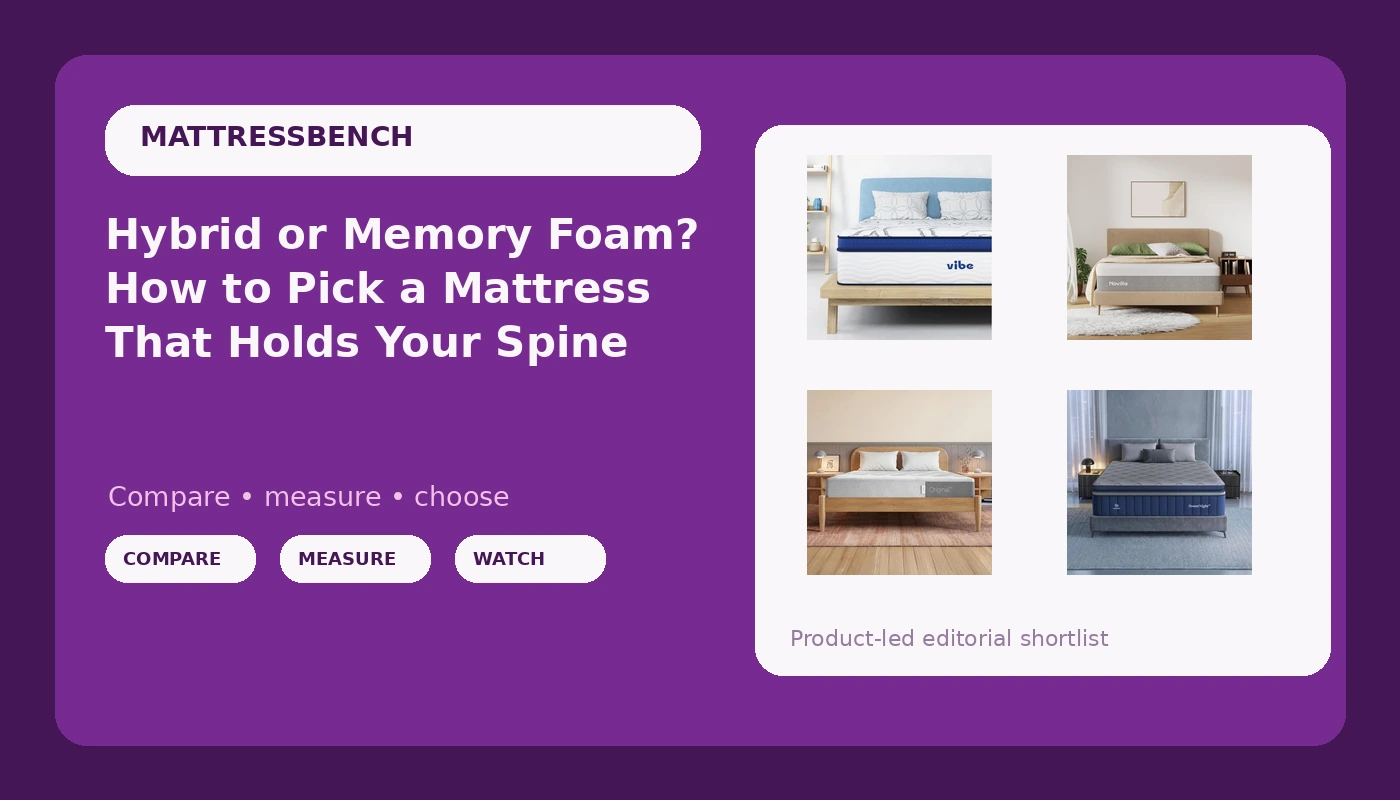
The two mattresses people ask me about most are hybrid and memory foam mattresses, and the real question underneath is usually about back pain: will this thing still hold my spine at six in the morning? Both categories can do that job, and both can fail at it. The difference is structural. A hybrid pairs a coil support core with foam comfort layers on top. An all-foam mattress uses foam all the way down, including the layer doing the supporting. That single decision shapes airflow, edge support, motion transfer, and how the surface behaves under your hips and shoulders. What follows is the framework I use to think through the choice, plus four current listings that represent genuinely different answers to it.
Related: How Mattress Firmness Affects Spinal Alignment →
Quick answer
Support comes from how a mattress holds your spine, not from the word printed on the label. A hybrid gives you a coil core that resists compression and moves air, with foam above it for contouring. An all-foam mattress gives you deeper conforming and usually less motion transfer, at the cost of edge firmness and airflow. Neither category is inherently better, and "medium" is a brand's own description rather than a standard, so the same word can cover two very different surfaces.
Four useful options
| Model | Best fit | What stands out |
|---|---|---|
| Sweetnight CoolNest Hybrid Queen Size Mattress 14 Inch, Cooling Pillow Top | Sleepers who want a taller hybrid with a cooling pillow top | 14-inch hybrid profile in queen size |
| Vibe Quilted Hybrid Mattress, 12-Inch Innerspring and Pillow Top Gel Memory Foam Mattress, Fiberglass Free, CertiPUR-US Certified Bed in a Box, Full, White | Shoppers who want a fiberglass-free hybrid that ships compressed | Fiberglass free, CertiPUR-US certified, full size |
| Novilla Bliss Queen Size Mattress, 12 Inch Gel Memory Foam Mattress Queen | Sleepers who want an all-foam queen | 12-inch gel memory foam build |
| Casper Sleep Original 11" Hybrid Queen Mattress, Medium Feel | Sleepers who want a medium-feel hybrid in queen | 11-inch hybrid from an established brand |
The cooling pillow-top hybrid: Sweetnight CoolNest Hybrid Queen Size Mattress 14 Inch
A 14-inch profile is on the taller side, and that matters for two reasons. First, more foam above the coils usually reads as plusher, because your hips sink through more material before they meet the support core. Second, taller mattresses need deeper sheets, so measure your fitted sheet pocket depth before you order. On the cooling question, be skeptical of the word itself: a pillow top changes how air moves near your body, but a gel or phase-change layer is not air conditioning. The coil core and the cover fabric do more for heat than any single layer in the stack.
The fiberglass-free hybrid: Vibe Quilted Hybrid Mattress, 12-Inch Innerspring and Pillow Top Gel Memory Foam Mattress, Fiberglass Free, CertiPUR-US Certified Bed in a Box, Full, White
Fiberglass is worth understanding because it shows up in the fire barrier of some compressed mattresses, and if a cover is unzipped or damaged, glass fibers can escape into a room. A listing that states fiberglass free removes that specific concern, though it says nothing about the rest of the construction. CertiPUR-US is a foam certification covering content and emissions for the foam components, not a verdict on the finished mattress. Note the size here: this one is full, which is narrower and shorter than a queen, so check your frame and your sleeping arrangement before assuming it is interchangeable.
The all-foam option: Novilla Bliss Queen Size Mattress, 12 Inch Gel Memory Foam Mattress Queen
Memory foam earned its heat reputation honestly: dense foam with closed airflow traps warmth, which is why so many all-foam beds add a gel layer to pull heat away from the surface. It helps at the margin. It does not turn the mattress cool. The real trade-offs with an all-foam build are edge support, where foam compresses under a seated body in a way coils resist, and motion transfer, where foam usually wins by absorbing movement instead of transmitting it. If you share a bed with someone on a different schedule, that second point can matter more than anything else on this page.
The medium-feel hybrid: Casper Sleep Original 11" Hybrid Queen Mattress, Medium Feel
"Medium" in this listing is the manufacturer's description of feel, not a measurement, and it does not tell you where the transition between foam and coils sits. On an 11-inch hybrid the comfort layers are thinner than on a 14-inch build, so you generally sit closer to the support core. For a back sleeper who wants the surface to stay relatively level, that can be an advantage. For a side sleeper with broad shoulders, a thinner comfort stack can mean more pressure at the shoulder and hip, because there is less material to let those points sink in.
Prices and availability may change. Product images, names, and retailer links are matched to verified listings. No current price, rating, stock status, or measured result is stated here without current evidence.
What support actually means in a mattress
Support is not the same thing as firmness, and the industry conflates them constantly. A mattress supports you when it keeps your head, ribcage, and pelvis roughly stacked while you lie on your side, and keeps your spine in its natural curve while you lie on your back. A rock-hard mattress can fail that test, because it pushes your shoulders and hips up and lets your lower back arch into a gap. A soft mattress can fail it too, by letting your hips sink until your lumbar curve flattens.
The tool that makes this visible is a pressure map: a sensor pad that shows where your body weight concentrates across the surface. It is the closest thing to an objective read on whether a mattress is holding you evenly or loading one spot. Two people of different weights on the same bed will produce two different maps, which is why a mattress that works for your partner can hurt you.
Underneath the surface feel, three structural details drive how long a mattress keeps doing its job. Foam density, the weight of the foam per cubic foot, determines how quickly a comfort layer loses its recovery. Coil quality and edge reinforcement determine whether the perimeter holds you when you sit on the side of the bed, which you do more often than you think while putting on shoes. And the fire barrier and cover materials determine what is actually next to your skin for the next several years.
Why the firmness label does not travel
Every brand's medium is different, and there is no governing standard that makes the word mean anything specific. One company's medium is another company's firm. That is not a marketing trick so much as an absence of regulation: feel is described by the seller, and the seller defines the scale.
Your own body is the other variable. Body weight changes how far you sink into a comfort layer, so a 120-pound side sleeper and a 220-pound back sleeper experience the same mattress as two different beds. Sleeping position changes the target as well. Side sleepers need enough give at the shoulder and hip to keep the spine straight. Back sleepers generally need the midsection held up rather than allowed to drop. Stomach sleepers need the hips prevented from sinking, or the lower back takes the load.
Cooling claims deserve the same skepticism. A gel-infused layer, a phase-change material, or a "cooling" cover can change how warm the surface feels for the first stretch of the night, but none of them refrigerate anything. What actually moves heat is airflow through the mattress, which is where a coil core has a structural advantage over a solid foam block, and breathability in the cover and sheets. If night sweats are your main complaint, fix the room temperature and the bedding first.
- Lie on the mattress in your normal sleeping position for at least fifteen minutes, not on your back in the middle of a showroom.
- Check the edge by sitting on it with your full weight; if the perimeter collapses, you will feel it every morning.
- Ask what the trial period actually is, and who pays return shipping on a compressed bed in a box.
- Read the warranty for the sagging threshold it covers, since a two-inch depression clause tells you what the maker expects.
- Confirm the size against your frame, especially if you are moving from full to queen or adding an adjustable base.
Practical guidance before you buy
- Measure your bed frame and your fitted sheets before choosing a thicker profile, since deep mattresses need deep pockets.
- Give any new mattress a full thirty nights before judging it, because the first week is break-in, not the finished feel.
- Rotate a foam or hybrid mattress head to foot every few months to even out where your body weight lands.
- Keep the foundation flat and supportive; a sagging box spring or slatted base will undo a good mattress.
- If a mattress arrives compressed, give it the full expansion window in the instructions before you sleep on it, and photograph the cover before opening anything.
Which option should you choose?
Choose the Sweetnight CoolNest Hybrid Queen Size Mattress 14 Inch, Cooling Pillow Top when you want a taller hybrid in queen with a pillow top and you have deep-pocket sheets to match. Choose the Vibe Quilted Hybrid Mattress, 12-Inch Innerspring and Pillow Top Gel Memory Foam Mattress, Fiberglass Free, CertiPUR-US Certified Bed in a Box, Full, White when a fiberglass-free fire barrier matters to you, you want a compressed hybrid, and full is the size you actually need. Choose the Novilla Bliss Queen Size Mattress, 12 Inch Gel Memory Foam Mattress Queen when you want an all-foam queen and you value motion isolation over a firm edge. Choose the Casper Sleep Original 11" Hybrid Queen Mattress, Medium Feel when you want an 11-inch hybrid in queen with a medium feel as the brand describes it.
None of these listings tells you how the mattress will feel under your specific body weight, and none of them substitutes for lying on the bed. A name like medium is the seller's own description, not a measurement, and no product page can tell you whether your shoulders will be comfortable at hour six.
The bottom line
Hybrid or memory foam is the wrong first question. The right one is whether the mattress holds your spine in the position you sleep in, and that depends on the relationship between your body weight, your sleeping position, and the thickness of the comfort layers above the support core. Use the firmness label as a starting point, not an answer. Use the construction, the trial terms, the warranty, and the size to narrow the field, and then judge the mattress with your own body on your own frame.