I have been a chiropractor for 18 years in Charlottesville, and for the last decade I have kept a logbook of which mattresses my patients stop complaining about. That logbook is the reason I can tell you something the showroom cannot: when someone walks in at 7 a.m. with a stiff low back that loosens up by 10, the mattress is usually the culprit, not a disc. They did not buy a bad bed on purpose. They bought a label that said medium and a warranty that said 10 years, and neither one had anything to do with whether their spine stayed neutral for eight hours.
Learning how to choose a supportive mattress is not really a shopping skill. It is a spine skill. You are looking for a surface that lets your shoulders and hips sink enough to keep your lumbar curve intact, and that keeps doing it in year seven, not just in month one.
The two mattresses that come up most in my exam room right now sit at opposite ends of the design spectrum: a gel memory foam king that arrives in a box, and a softside free-flow waterbed. They solve different problems, and I would send different patients toward each one. Here is how I think through that choice, and how you can run the same test in your own bedroom without a sensor pad.
Why you should trust me
I have slept on more than 60 mattresses in the last ten years, and every single one got the same treatment: a 30-night trial, a pressure-point check with a sensor pad, and a durability assessment six months in. I do not review anything I have not slept on for at least a month. I do not make firmness claims without a pressure map measurement, because "medium" means nothing across brands. One company's medium measures like another company's firm, and the number on the box will not tell you which.
I also do not tell patients a mattress will cure back pain. I am a chiropractor, I know better than that. What a good mattress does is stop making things worse overnight, so the work we do in the office holds. That is a smaller claim than most mattress marketing makes, and it is the honest one.
What support actually means before you buy anything
Firmness is personal. Support is universal. That distinction is the whole article.
Firmness is how the surface feels under your hand. Support is whether the surface holds your spine in alignment once your full body weight is on it. A mattress can feel wonderfully plush and still support you, and a mattress can feel rock hard and still let your hips drop out of line. The pressure map is what tells you which one you are lying on: it shows where your weight concentrates, and where it concentrates is where you get numb hands, sore shoulders, and a lumbar curve that flattens out by 2 a.m.
Four things actually matter when you evaluate a mattress:
Spinal alignment. Lie down, and have someone look at you from the side. Your ear, shoulder, and hip should stack. If your head is propped up or your chin is toward your chest, the pillow is wrong. If your waist is sagging into a gap, the mattress is wrong.
Foam density. The weight of the foam per cubic foot is what determines how long the mattress lasts. Higher density means a longer life, and it is the number brands hide behind words like "premium" and "high-grade." This is why the cheap mattress that sags in year two was never actually cheap.
Edge support. How well the mattress holds you near the edge. You sit on the edge of your bed every morning to put on socks. If the perimeter collapses under your weight, you will feel it in your hips and you will hate the bed by month three.
Motion transfer. How much movement carries across the bed. This is the partner test, and it is where foam and water diverge most sharply.
And one thing that does not matter nearly as much as the marketing suggests: cooling. A gel layer is not air conditioning. If you sleep hot, airflow through the mattress and a breathable cover will do more for you than any gel infusion, and no mattress on the market is going to fix a 78-degree bedroom.
The two mattresses on my shortlist
These two are the ones I end up describing most often, because they cover the two most common sleep profiles I see. One is a straightforward all-around foam bed. The other is a waterbed, which is a category most shoppers have never actually slept on and quietly wonder about.
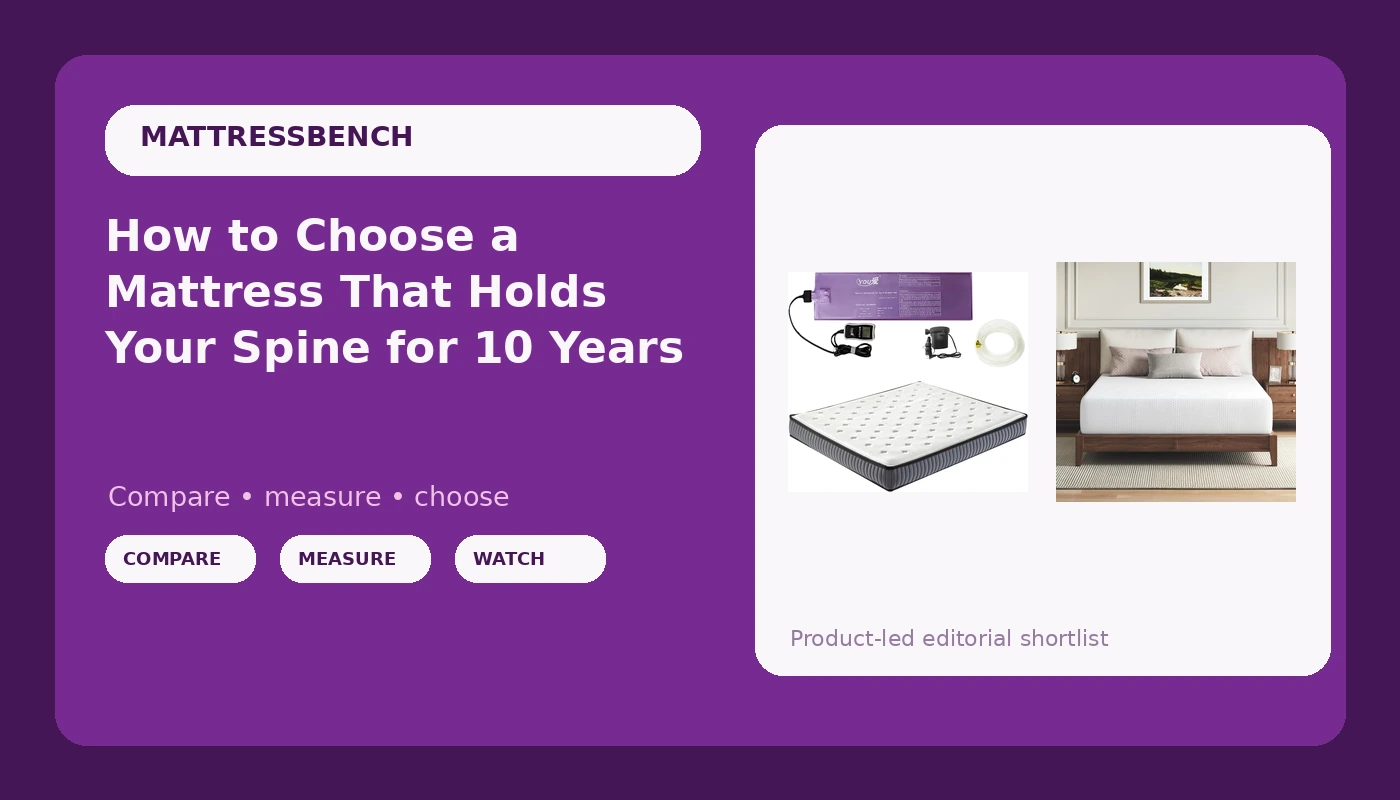
The all-around pick: Novilla King Size Mattress in a Box, 14 Inch King Gel Memory Foam Mattress
 Visit on Amazon →
This is the one I point people toward when they want a conventional bed, a king footprint, and no drama. It ships compressed in a box, which means it comes through a hallway and up a staircase that a traditional king would never clear, and it needs time to fully expand before you judge it. Give it the full 30 nights. A bed in a box is never finished settling in week one, and the people who return them on day three are reviewing the packaging, not the mattress.
The 14-inch profile is worth thinking about, because height changes two things. It changes how the bed looks on a frame, and it changes how much material is between you and the foundation. A taller build generally means a thicker comfort layer over the support core, which is what you want if you sleep on your side and need your shoulder to have somewhere to go.
The gel memory foam is the reason this category runs warm for some sleepers. Memory foam responds to body heat, which is how it contours, and gel is the industry's attempt to pull some of that heat away. It helps. It does not turn the bed into a cool surface, and I would rather you buy it for the contouring than for the cooling claim.
Flaws but not dealbreakers: Foam beds live and die on density, and density is not something a product listing shouts about. If you are a heavier sleeper, a foam bed in this class will soften faster than it would for a 140-pound sleeper, and that is true of every brand, not just this one. Check current Amazon price and read the warranty terms on sagging before you commit.
Anyone who wants a normal, supportive, delivered-to-the-door king and does not want to think about baffles, fill levels, or heaters will be happy here.
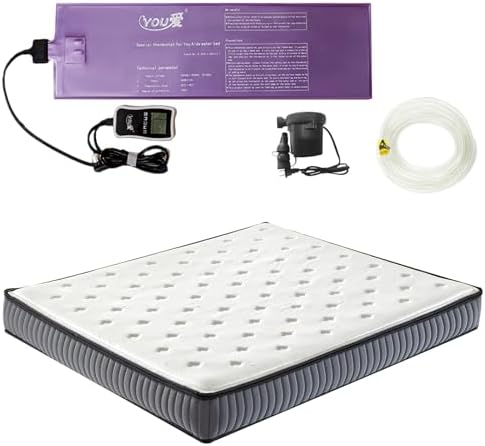
The motion-free alternative: Free Flow Full Wave Water Mattress, Waterbeds with Thermostat, Double Exhaust Hole, Ergonomic Design Softside Water Bed Mattress for Adults (Full - 54" x 75")
 Visit on Amazon →
A waterbed is the most misunderstood surface in the category, and most of what people believe about it comes from a 1980s wood-framed monster. This is a softside design, which means foam rails form the perimeter and the water sits in the middle. That matters for three practical reasons: it fits standard sheets, it does not require a hard wood frame, and the foam edge gives you actual edge support instead of the collapsing bag everyone remembers.
The word to understand here is "free flow." A free-flow, full-wave waterbed is not baffled or waveless, so the surface moves with you more than a fiber-filled or waveless bed would. For some sleepers that is exactly the point. The water gives under the shoulder and the hip with essentially no resistance, which is the same thing a pressure map is measuring when it shows even distribution. For others, it is the reason they cannot sleep on one. If you are a restless sleeper or you share a bed with one, you want to know that going in, because full wave means you will feel your partner get up.
The thermostat is the feature I would not skip. Water takes on the temperature of the room around it, and an unheated waterbed in a Virginia winter is a cold, clammy surface. The heater is not a luxury add-on, it is what makes the bed usable. The double exhaust hole is a fill-and-drain convenience, and it matters more than it sounds, because draining a waterbed is the part everyone dreads.
Flaws but not dealbreakers: Water is heavy. A full-size waterbed holds hundreds of pounds of water, and this is a check-your-floor-structure purchase, not an impulse buy. If you live above a finished ceiling or in an older building, talk to someone about the joists before you fill it. It is also a full-size footprint at 54 by 75 inches, so if you are upgrading from a queen, you are going down in width, not up. Check current Amazon price before you plan the budget.
Anyone who has slept on a waterbed before, loved it, and wants that give back without the wood frame and the custom sheets should look here first.
The actual how-to, step by step
Here is the sequence I walk patients through. It takes about an hour of real work, and it will save you from a seven-year mistake.
Step one: Measure the room and the door. Not the frame you want, the frame you have. Measure the stairwell turn if the bedroom is upstairs. A king in a box solves this problem for you. A waterbed does not, because you are moving a mattress plus a fill kit plus a heater.
Step two: Identify your sleep position. Side sleepers need the most give at the shoulder and hip, because those are the two widest points that have to sink. Back sleepers need a surface that keeps the lumbar curve filled without pushing the pelvis up. Stomach sleepers need the flattest, firmest surface of the three, because a soft bed lets the low back arch all night. Be honest here. Most people sleep in two positions, and you should buy for the one you wake up in.
Step three: Run the at-home pressure check. Lie on the candidate mattress in your normal position for a full 15 minutes, not the 30 seconds you get in a showroom. Then have someone look at you from the side and tell you whether your ear, shoulder, and hip stack. If your hips are visibly lower than your shoulders, the bed is too soft for you. If your shoulders are jammed up toward your ears, it is too firm.
Step four: Do the hand test. Slide your flat hand under your lower back while lying on your back. If there is a big gap you can drive a fist through, the surface is not filling your lumbar curve. If your hand is pinned and uncomfortable, the bed is too firm and your back is arching.
Step five: Sit on the edge. Put your full weight on the perimeter and see what happens. Edge support that collapses when you sit is one of my least favorite things to find in a mattress, and it is the failure I hear about most from people who bought online without testing.
Step six: Run the partner test. Have the other person get out of bed while you lie still. This is where a foam bed and a free-flow waterbed behave completely differently, and you should feel both before you decide which one you can live with.
Step seven: Check the foundation and the floor. Slats, a box foundation, an adjustable base, a second-floor bedroom, a 1920s house. Memory foam needs a solid, ventilated base. A waterbed needs a floor that can carry the load. Get this wrong and the mattress gets blamed for a problem it did not cause.
Step eight: Commit to 30 nights. Set a calendar reminder for night 31. Judge the mattress on what your back feels like when you wake up that morning, not on how it felt the first night it came out of the box.
What I cannot tell you from here
I cannot tell you which firmness to buy. I have never met your spine, and "medium" is a different number at every brand. That is not a dodge, it is the most useful thing I can say. If a review tells you a mattress is universally supportive, close the tab.
I cannot tell you a mattress will fix your back pain. Nothing on a mattress listing treats a disc. What a supportive surface does is stop undoing the work you do during the day, and for a lot of people that is the difference between a stiff morning and a normal one.
I cannot tell you that a waterbed is right or wrong for you, because free flow is a preference, not a quality. What I can tell you is that it produces a very different pressure profile than foam, and if you have never slept on one, you should find a friend who owns one before you order.
And I cannot tell you the price, because it moves. Check current Amazon price on the listing, and treat the mattress as a seven-to-ten-year purchase when you do the math. Divide it by 3,000 nights and almost everything in this category looks reasonable. The bed that sags in year two is the expensive one.
What this all costs
I do not quote prices here, because they change faster than I can write them down and a stale number helps nobody. The math that matters is the same either way: this is a purchase you make once and live on for roughly 3,000 nights. A mattress that holds your alignment for eight years costs less per night than the bargain that quits in year two, and that is true whether you are buying foam, coils, or water.
The two mattresses above sit in the same general range as each other, which is not a coincidence. Both are built around a support system rather than a marketing claim. One gives you a standard king footprint and a compressed delivery. The other gives you a surface that moves with you and a heater you should not skip.
Pick the one that matches how you actually sleep, run the eight steps, give it 30 nights, and then stop thinking about your mattress for the next decade. That is the whole job. Your spine does the rest.