Ninety seconds on your back in a showroom with your shoes still on is not a test of a mattress for back support. It is a test of whether the bed feels nice when you are tired. Those are different questions, and only one of them matters at 3 a.m. on night 40.
I have watched the consequences of that bad test in my clinic for 18 years. A patient comes in with low back pain that started "for no reason," and after the intake questions we get to the mattress. Ten years old. Body impressions where the hips sleep. A "medium" that measures like a brick the moment you put a pressure map on it.
The fix is not a more expensive mattress. It is a better test. What follows is the method I run on every bed I sleep on, and the one I hand to patients who want to know how to judge a mattress for back support before they spend money. It has three parts: a 15-minute showroom test, a 30-night home trial with a logbook, and a six-month durability check. Skip any one of the three and you are guessing with your spine.
Why you should trust me
I have been a chiropractor for 18 years in Charlottesville, Virginia, and I started reviewing mattresses because too many of my patients were treating a worn-out bed with appointments. I have slept on more than 60 mattresses in the last decade. Every one of them gets the same protocol: a minimum of 30 nights, a pressure-point check with a sensor pad, and a durability assessment after six months of use.
I keep a logbook of which mattresses my patients stop complaining about. That logbook is worth more than any showroom, because it tracks what happens in month four, not what happens in minute four.
Two things I will not do. I will not tell you a mattress cures back pain. It does not, and I am a chiropractor, so I know better. If your pain persists past a few weeks, that is a conversation with a clinician, not a shopping trip. And I will not call a bed "medium" without a pressure map, because every brand's medium is a different number and the label on the tag means nothing.
How I picked and how I tested
This is a how-to guide, not a ranking. The two mattresses below are the beds I use to demonstrate the method because they represent the two constructions people ask me about most: an all-foam queen and a compact hybrid twin. One is the shape of bed a couple buys for a guest room or a first apartment. The other is the shape of bed a parent buys for a kid, a dorm, or a small second bedroom.
Here is what I measure on every mattress that crosses my table, and what you can measure too, with or without gear.
The pressure map is the honest test of support. A sensor pad shows where your weight concentrates. Hips and shoulders should not be doing all the work. If the map is a bright blob under your pelvis and nothing under your mid back, the bed is not holding your lumbar curve, no matter how good it feels for the first ten minutes.
Edge support is the second measurement. Sit on the edge of the bed, six inches in from the corner, feet on the floor. If the foam collapses under your sit bones and you slide forward, you will feel that collapse every time you get out of bed. On a purchase you keep for seven to ten years, edge collapse is usually the first thing to fail.
Motion transfer is the third. Put a hand flat on the mattress a foot away from your partner and have them roll over. If you feel the roll travel through the surface, you will feel it at 2 a.m.
Foam density is the fourth. Higher density foam weighs more per cubic foot and lasts longer. It is the number marketing never prints and the number materials engineers always ask about first.
And one rule sits above all four: I do not rate anything without 30 nights of sleep on it. A showroom is a first date. Thirty nights is a relationship.
The two mattresses this method applies to
The method below works on any bed. These are the two I point people toward when they want to run it on a specific construction without overthinking the shopping part.
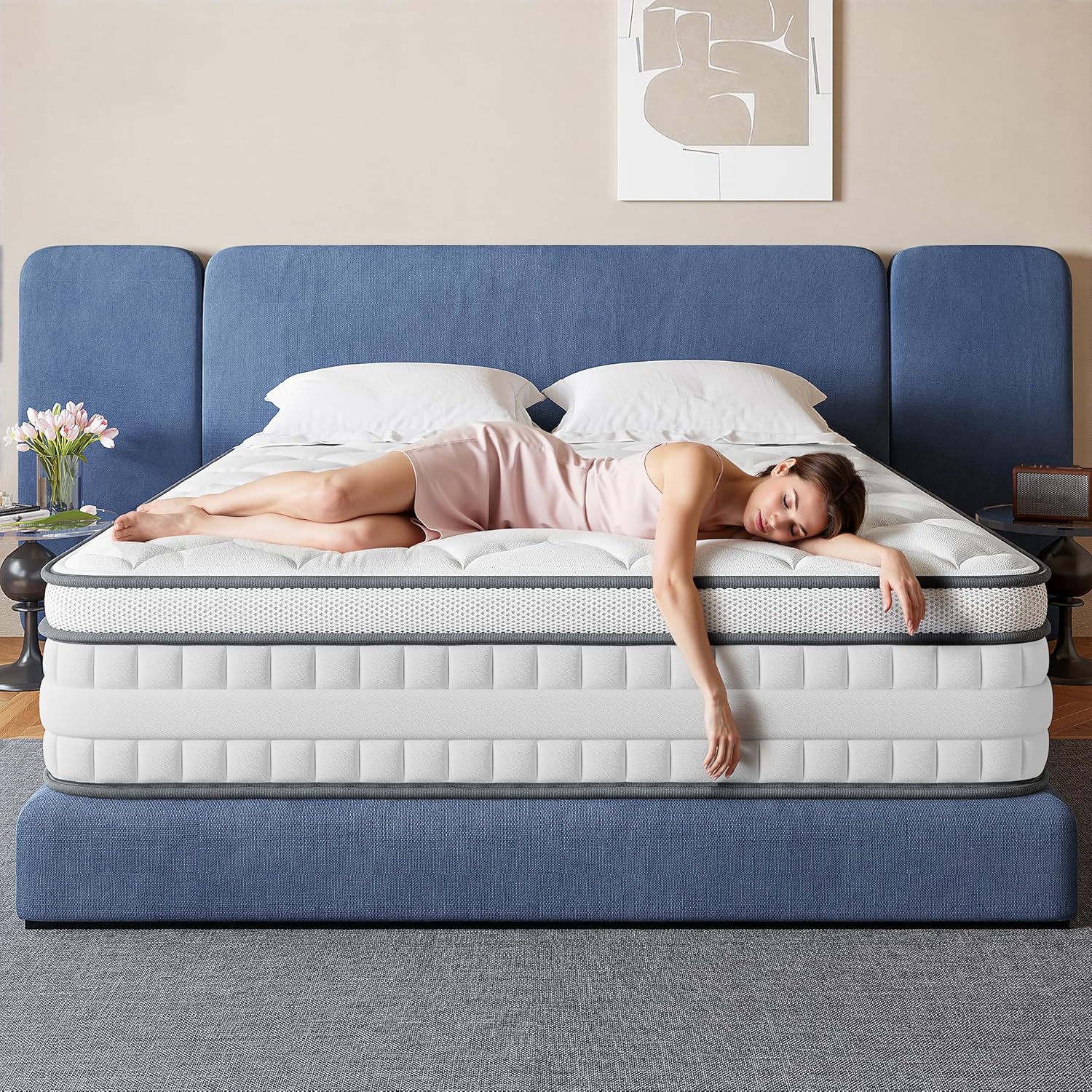
Budget pick: Homkdom 12 Inch Twin Hybrid Mattress with Memory Foam
 Visit on Amazon →
A 12 inch twin hybrid means coils plus a memory foam layer on top, and that combination is the reason I put it first for small rooms. The coil core is what gives a hybrid its edge support and its airflow, and both of those matter more in a twin than people expect, because a twin gets sat on, leaned on, and climbed over constantly. The memory foam layer on top is what keeps the pressure off a shoulder or a hip.
Twin size also means this is not the bed for a couple. It is the bed for a kid's room, a dorm, a bunk replacement, a guest corner, or one adult in a small apartment who wants a hybrid feel without paying queen hybrid money. If you are running the edge support test from step five, hybrids usually pass it better than all-foam at the same thickness, and this one's 12 inch profile gives the coil unit room to do its job.
Flaws but not dealbreakers: Hybrid coils mean more motion transfer than a pure foam bed, so a light sleeper sharing a twin with a restless kid will notice the bounce. Twin sizing also rules out two adults.
Anyone furnishing a small bedroom, a dorm, or a guest room who wants coil support rather than a slab of foam should start here. Check current Amazon price.
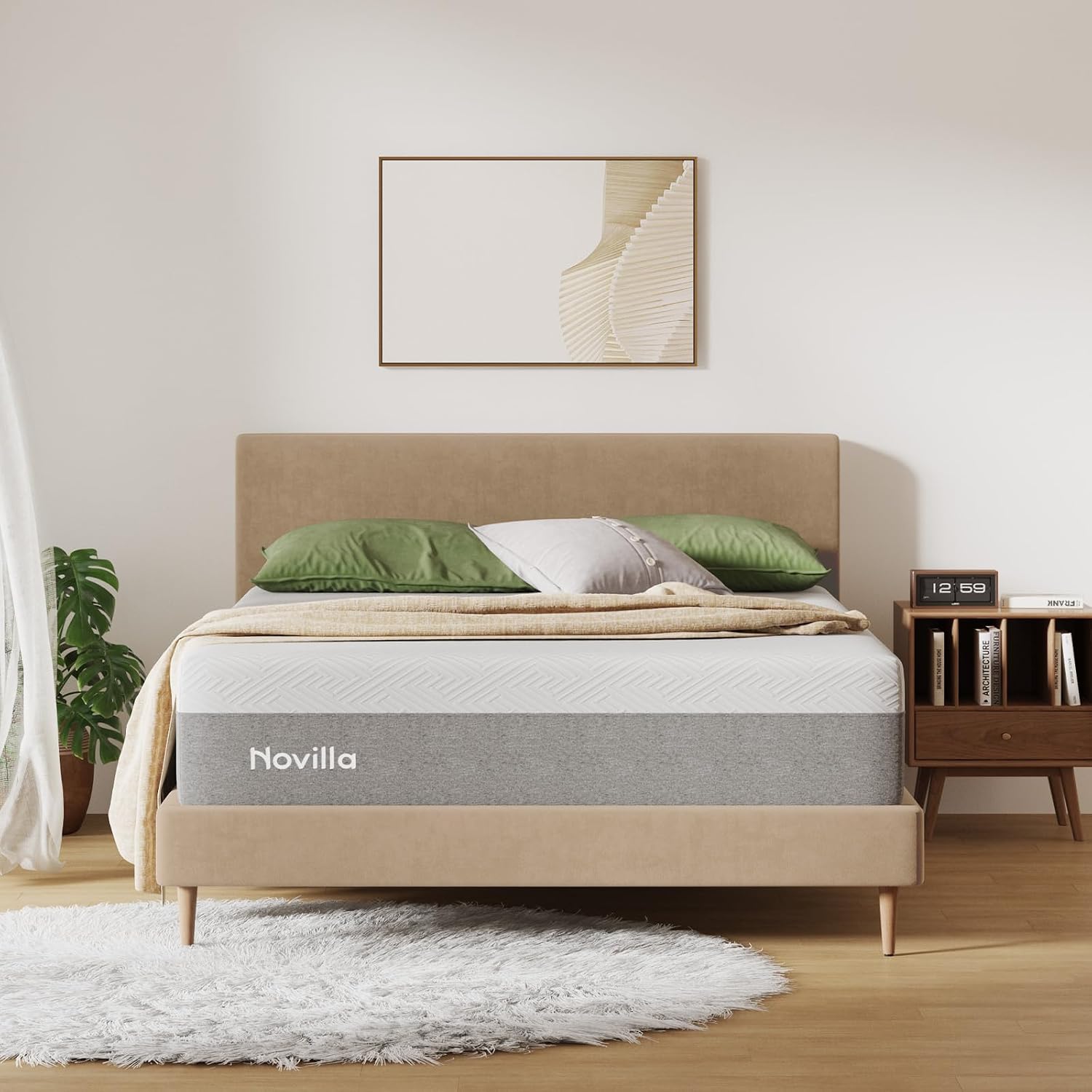
Our pick: Novilla Bliss Memory Foam Mattress Queen, 10 Inch Gel Queen Mattress
 Visit on Amazon →
This is the all-foam queen, and it is the bed most couples actually end up buying, so it is the one worth explaining properly. The 10 inch profile is a three layer build: a base foam for structure, a transition layer, and a gel infused memory foam on top. That gel layer is where the marketing gets loud, so let me be blunt about it. Gel infusion moves heat away from the surface a little faster than plain memory foam. It does not air condition your bedroom. If you sleep hot, airflow in the room and a breathable cover will do more for you than any gel claim on a box.
What the memory foam top layer genuinely does is pressure relief, and that is not marketing. Memory foam conforms to the shoulder and the hip instead of pushing back against them, which is exactly what you want if you sleep on your side and wake up with a numb arm. It is also why motion transfer is low on an all-foam bed, which matters if your partner gets up before you do.
A queen at 10 inches is the honest middle of the category. It is thick enough to support an average adult without a box spring, thin enough to fit standard sheets and a standard bed frame, and sized for two people who want the whole width. If your pressure map shows hot spots under the hips on a firmer bed, this is the construction to try.
Flaws but not dealbreakers: All-foam beds run warmer than hybrids and their edges are softer, so if you sit on the side of the bed every morning to put on shoes, expect more give here than on the hybrid above. Check current Amazon price.
The eight-step test, in order
Step one: Match the bed to the sleeper, not the bedroom. Side sleepers need give at the shoulder and hip. Back sleepers need a lumbar curve that stays supported. Stomach sleepers need a flat surface or they wake with a twisted neck. Write down which one you are before you shop, because the salesperson will ask and the wrong answer costs you seven years.
Step two: Lie down properly in the store. Shoes off, coat off, ten minutes on your back and ten on your side, in your normal sleeping position. Bring your own pillow. If a store will not let you do this, that store is telling you something useful.
Step three: Run the alignment check. Lie on your back and slide your hand, palm down, under your lower back. If there is a gap big enough for your whole hand to disappear, the bed is too firm for your curve. If your hand is pinched and you cannot get it in at all, the bed is too soft. A slight gap that your hand just fills is the target. Then roll onto your side and check that your spine runs in a straight line from the base of your neck to your tailbone, not a hammock.
Step four: Run the pressure check without a sensor pad. On your side, pay attention to your shoulder and your hip. A hot spot or a tingle in ten minutes means the top layer is not giving enough. Feeling nothing at all is the target.
Step five: Test the edge. Sit six inches in from the corner with your feet on the floor, then lie across the edge on your back. If you roll toward the middle, the perimeter is soft, and you will feel it every morning for a decade.
Step six: Test motion transfer. Put a hand flat on the far side of the mattress and have your partner roll over. Sleeping alone? Press your palm into the bed a foot away and watch how far the surface moves. On an all-foam bed it should barely register.
Step seven: Run the 30-night trial with a logbook. Night one: how long it took to fall asleep, how many times you woke, where you ached in the morning. Repeat for 30 nights. Every new mattress feels wrong for the first week simply because it is new. Nights 14 through 30 are the real review, and without notes you will not remember night 9 by the time night 25 arrives.
Step eight: Check for sag at six months. Lay a yardstick or a level across the mattress where you sleep. If you can see daylight between the straight edge and the surface, that is a body impression. Under an inch is normal on foam. Past an inch and a half, you have a warranty conversation and a data point about density.
One caveat that saves people money: a firm mattress plus a soft topper is not the same as a supportive mattress, and a topper cannot fix a bed that has already sagged. If the base foam is done, the topper just makes the hole softer.
Where other mattress types fit
If the pressure map on an all-foam bed is not giving you enough support, a hybrid is the next stop. Coils under foam add edge support, airflow, and a firmer feel under the hips, and that is the tradeoff the twin above represents at a smaller size. Traditional innerspring beds without a foam top layer are the firmest of the three and the easiest to move around on, which some back sleepers prefer. Latex is the durable, bouncy, expensive option, and it lasts, but it feels nothing like memory foam.
None of these is the right answer on its own. The right answer is whichever one passes steps three, four, and five for your body.
What this all costs
Whatever the two beds above cost when you check them today, the math that matters is cost per night. A mattress is a seven to ten year purchase. Divide the price by 2,555 nights and you have the real number. A bed that sags in year two was never cheap, even if the sticker looked like a bargain.
The other half of the math is what you skip. A professional pressure map session, a mattress topper you buy to fix a bed that is already failing, a chiropractor visit every three weeks because your hips sink four inches into a worn-out foam layer. I have watched patients spend the price of a good mattress on appointments in a single year.
Rotate the mattress every three months, head to foot, and put it on a foundation with slats no more than three inches apart if it is foam. That is free, and it buys you years.
The bottom line
The showroom test is 15 minutes. The home trial is 30 nights. The durability check is one yardstick at six months. That is the whole method, and it costs nothing but attention.
Your spine does not care what the tag says, what the box claims about cooling, or what firmness word the brand printed on the label. It cares whether the surface holds your lumbar curve, whether your shoulder and hip can sink in without a fight, and whether the bed still does both in year five.
Test it that way, and you will buy one mattress instead of three.