Most people treat a firm memory foam mattress setup as a delivery problem. The truck arrives, the box lands in the hallway, and somebody wrestles it onto whatever frame was already in the bedroom. Then they wonder why their lower back aches by week three.
I have watched that sequence play out in my clinic for 18 years. A patient comes in with morning stiffness, I ask how old the mattress is, and the answer is usually "about ten years" or "it was my mother's." The mattress is part of it. The foundation under it is the other part, and so is the way the two were matched.
A firm memory foam mattress setup is really three decisions: the right firmness for your spine, the right frame for the mattress, and enough nights to judge both before you decide. Get those three right and you can stop thinking about your bed. Get them wrong and no amount of pillow shopping will save you.
This guide walks the whole job, from the frame you bolt together first to the trial window where you make the keep-or-return call.
Why you should trust me
I am a chiropractor in Charlottesville, Virginia, and I have been in practice for 18 years. I started reviewing mattresses because too many patients came in with lower back pain that traced straight back to a mattress they had owned for a decade. I have slept on more than 60 mattresses over the last ten years, and every one of them ran through the same protocol: a 30-night trial, a pressure-point check with a sensor pad, and a durability assessment six months in. I keep a logbook of which mattresses my patients stop complaining about.
I have a bias and I will name it. Firmness is personal, but support is universal. A mattress that lets your spine sag out of neutral is a mattress that hurts you, no matter how good it feels on night one. That is the standard I bring to this guide, and it is the reason the word "medium" does not appear anywhere in my recommendations. Every brand's medium is different, and a label is not a measurement.
How I picked and how I tested
This is a setup guide, not a mattress roundup, so the list is short on purpose. You need two pieces: a mattress, and a foundation that will hold it flat.
For the mattress, I looked for a firm memory foam build. Firm foam is the version I end up recommending to patients who sleep on their back or stomach, and to side sleepers who sink too deep into a soft bed and wake up with a sore lumbar spine. The Nectar below is a 12 inch firm memory foam mattress in queen, and it carries a one year trial. That trial length matters to me, because my own minimum before I trust a mattress is 30 nights. A longer window means you can run the same test at home without a return deadline breathing down your neck.
For the frame, I looked for a metal platform with real center support and enough height to use the space underneath. The JETO frame below is an 18 inch metal frame with storage space under it. I will be direct about one detail in that listing: it is a twin, and the mattress above is a queen. Sizes have to match, and I walk through that in the setup steps below.
Where a number in this article comes from a manufacturer's specification rather than my own measurement, I say so. I do not publish pressure map results for a mattress I have not slept on for 30 nights, and I am not going to pretend otherwise.
What you need before you start
The two pieces below are the ones this guide is built around: a firm memory foam mattress and a metal platform frame with storage. Read both sections before you order, because the sizes have to line up.
Our pick: Nectar 12” Memory Foam Mattress, Queen, Firm Feel, 1-Year Trial
 Visit on Amazon →
A firm memory foam mattress is the right starting point for a lot of backs and the wrong one for a lot of others, so let me sort you before you buy. If you sleep on your back, firm foam holds your lumbar curve instead of letting your hips drop. If you sleep on your stomach, firm is close to mandatory, because a soft surface pushes your pelvis down and your neck up. If you are a strict side sleeper with wide shoulders, firm can be too much at the shoulder, and you may do better with a softer comfort layer over a firm support core.
What this one gives you is a 12 inch memory foam construction in a queen, in the firm feel, with a one year trial attached. The trial is the part I care about most. Firmness is personal and support is universal, and the only honest way to learn which one you got is to sleep on it. One year is long enough to run a real 30 night test and still have room to think.
A few things to expect. Memory foam sleeps warmer than a coil bed, and I say that as someone who thinks most cooling claims in this industry are marketing. A gel layer is not air conditioning. If you run hot, keep the bedroom cool and skip the heavy quilted mattress pad. Second, memory foam needs a flat, rigid foundation. Put it on a sagging box spring and you have bought foam that is now shaped like a hammock.
Flaws but not dealbreakers: Firm is firm. If you have never slept on a firm memory foam bed, the first week can feel like a lot of mattress underneath you. That is exactly what the trial window is for.
Back and stomach sleepers, and side sleepers who wake up with a sore lower back from sinking, should start here.
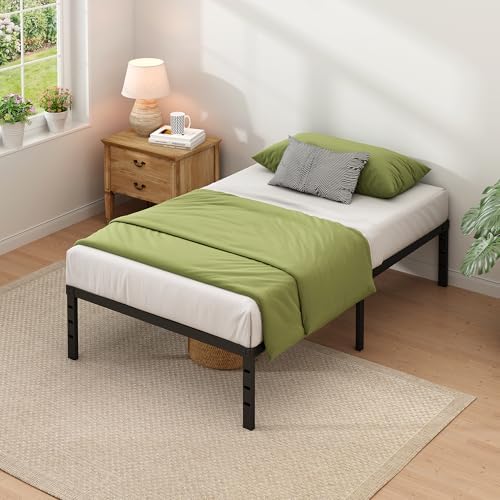
The foundation: NEW JETO Metal Bed Frame,Twin Size Bed Frame with Storage Space,18 Inch
 Visit on Amazon →
A metal platform frame does two jobs: it holds the mattress flat, and it gives you back the floor space under the bed. This one is an 18 inch metal frame with storage space underneath, which is the height that makes under-bed bins actually usable instead of a place where dust bunnies retire.
Here is the honest caveat, and it is the one people skip. This frame is a twin. The mattress above is a queen. A queen will not sit correctly on a twin frame, and the center support will not be under the load it needs to carry. If you are buying the queen Nectar, order the queen version of this frame. If you are outfitting a kid's room or a guest room, the twin is the right call, and it pairs with a twin mattress.
Platform frames also mean no box spring. That is not a cost-cutting trick, it is the correct setup for memory foam. Rigid beats springy every time under foam.
On the storage: use low, flat bins so they slide in and out without scraping the frame, leave a little air gap around them, and never stack anything so high that it presses up against the underside of the mattress. Foam needs to breathe.
Flaws but not dealbreakers: 18 inches is tall. If you are on the shorter side, or if you or your partner has mobility issues, that height is a real step up at night. Measure your current bed height and decide before you order, not after.
Anyone setting up a twin guest room or a kid's room, and anyone who wants the floor space back, gets the most out of this frame.
The actual setup workflow
Now the part you came for. Do these in order and you will not have to redo any of it.
Step one: measure first, order second. The frame size and the mattress size have to match exactly. Check the dimensions on the listing, then measure the space where the bed is going, including the clearance you need to walk past the foot of it. A bed that fits the room but blocks the closet is a bed you will resent.
Step two: build the frame before the mattress arrives. Empty the room, unbox the frame, and lay every piece of hardware out on a tray or a towel so you are not crawling around looking for a bolt. Start every bolt by hand before you tighten any of them. Once they are all threaded, tighten in a cross pattern, the way you would tighten lug nuts. Then go back after the first week and check them again.
Step three: work on a soft surface. Carpet or a moving blanket under the frame rails saves the finish and saves your knees. Metal frames scratch floors, and a scratch in a hardwood floor costs more to fix than the frame cost to buy.
Step four: verify the support surface. Memory foam wants a flat, rigid plane. If your frame uses slats, they need to be close together, with a center support that actually touches the floor or a leg. If a center bar is floating in the air, it is decoration, not support.
Step five: skip the box spring. A box spring adds flex under the foam. Flex is what lets your hips sink out of alignment while your shoulders stay up. If you already own a box spring and want to keep it, put a sheet of plywood over it, cut to the size of the mattress, and call it a platform.
Step six: let the mattress decompress. Follow the instructions that come in the box for how long to wait. Do not put a plastic protector or a heavy quilted pad on it before it has finished expanding, and give it the full time before you judge anything about how it feels.
Step seven: sleep on it for 30 nights before you decide anything. This is not arbitrary. The first week is your body arguing with a new surface. The second week is your body adapting. By night 30 you have real information. Keep a short log: morning stiffness, pressure at the shoulder and hip, how many times you wake up, and whether you end up on the couch. My patients who keep the log make better decisions than the ones who go on feel alone.
Step eight: check your alignment honestly. You do not need my sensor pad to run a version of the pressure map at home. Ask yourself where you feel pressure in the first ten minutes after you get up. If your arm goes numb, that is a shoulder problem, usually too firm at the shoulder or a pillow that is the wrong height. If your lower back aches in the morning and eases as the day goes on, that is usually a mattress that is too soft, and your hips are sinking. A mattress that holds your spine in neutral should leave you with no clear answer to the question "where does it hurt."
Step nine: rotate and maintain. Follow the manufacturer's care instructions for rotation. Most foam beds get rotated head to foot rather than flipped, and most people never do it. Check the frame bolts at the one month mark, and keep the under-bed storage from blocking airflow around the base of the mattress.
Step ten: put the trial deadline on your calendar. Set a reminder two weeks before the trial ends. The whole value of a long trial is the decision you make at the end of it, and nobody remembers the date on their own.
The competition and why it lost
I am not naming competing mattresses here, because this is a setup guide and not a roundup. What I can tell you is which approaches lose, and why.
The box spring loses. It was designed for an innerspring mattress that needed to flex with the coils. Under memory foam, that flex works against you, and the foam takes a set in the shape of your sag.
The soft pillow top loses, for most of the people who ask me about back pain. A thick soft comfort layer feels wonderful in the showroom and lets your hips drop out of neutral by the end of the night. If you want soft, get soft on top of a genuinely firm support core, not soft all the way down.
The frame without center support loses. A metal rail that spans the whole width with nothing under the middle will bow, and once it bows, the mattress above it bows with it.
The adjustable base is a different purchase, not a losing one. If you want a raised head and foot, buy one. Just do not buy it as a substitute for getting the firmness and the support surface right first.
The "medium" label loses. Every brand's medium is different, and if you cannot get a pressure map or a firmness number out of the listing, you are guessing. That is why I test with a sensor pad and not with a label.
What this all costs
I am not going to quote you a price, because prices move and a number in an article goes stale. Check current Amazon price on each listing, and check it on the day you buy.
What I can give you is the math that matters. A mattress is a seven to ten year purchase. Divide whatever you pay by the number of nights in that span, and you get your real cost per night. Do that calculation before you decide a cheap mattress is a bargain, because the cheap one that sags in year two was never cheap. You paid twice, and you spent the second year sleeping badly.
The frame is a different kind of purchase. A solid metal platform outlasts two mattresses if you keep the bolts tight, which is why I would rather see you spend on the frame once than replace a flimsy one in three years.
The trial window costs nothing. Thirty nights of logging costs you a few minutes a week. Those two things are the difference between guessing and knowing, and they are the only part of this process that is free.
The short version
Build the frame first and match the size to the mattress. Skip the box spring. Let the foam decompress fully before you judge it. Sleep on it for 30 nights and write down what your back tells you. Put the trial deadline on the calendar.
That is the whole job. A mattress is for sleeping, not for Instagram, and the test is whether it holds your spine. Do the setup right and you will not think about your bed again for years, which is exactly the point.