Most people shopping for a firm hybrid mattress for back support are shopping wrong. They walk into a showroom, lie down for ninety seconds, and pick whatever feels hardest, because hard feels like support. It is not. Hard is a surface. Support is what happens underneath your rib cage and your pelvis when you are unconscious for eight hours.
I am a chiropractor. I have spent eighteen years adjusting spines, and a large share of the lower back pain I treat traces back to a mattress that stopped holding alignment somewhere around year six. I have slept on more than sixty mattresses in the last decade and kept a logbook of which ones my patients stopped complaining about. That logbook is the reason I started reviewing mattresses instead of just handing out recommendations in the treatment room.
Here is the short version. Firmness is personal. Support is universal. A mattress either holds your spine in neutral or it does not, and you can figure out which one you are buying before you spend a dollar.
Why you should trust me
Eighteen years in practice, sixty-plus mattresses slept on, and the same test every single time: a 30-night trial, a pressure-point check with a sensor pad, and a durability assessment at the six-month mark. I do not publish a firmness number for a mattress I have not slept on for thirty nights, and I do not tell anyone their back pain will be cured by a purchase. I am a chiropractor. I know better than that.
What I do publish is the pressure map. It shows where your body weight concentrates, and it is the honest answer to the question every mattress brand wants to answer with a marketing word. If the map shows a spike under the shoulders and a spike under the hips, the mattress is fighting your spine. If it shows even loading across the whole curve, the mattress is doing its job.
How I picked and how I tested
This is a how-to guide, not a shootout. The two mattresses below are the current hybrid units in my 2026 rotation, and they sit at the two ends of the same question: do you need zoned firmness for lumbar support, or do you need motion isolation because you share a bed. Both are queen hybrids, both are boxed, and both are aimed at the same buyer with a different priority.
My method does not change. Every unit gets thirty nights, a pressure map at day one and day thirty, a check on the foam density and coil gauge where the brand publishes it, an edge support test where I sit on the perimeter and watch how far it compresses, and a motion transfer check where my partner gets out of bed at 5:40 a.m. and I note whether I wake up.
The numbers I trust: foam density of 1.8 pounds per cubic foot is the floor for a base foam layer, and anything under that will soften fast. Coil gauge works in reverse, so a lower number means thicker wire and a firmer feel. Zoned support means the middle third of the mattress uses firmer coils or a firmer foam insert, and it is the single most useful feature for a stomach or back sleeper with lumbar pain.
What I do not trust: the word medium. Every brand's medium is different, which makes the label useless as a comparison tool. Cooling claims are the other one. A gel layer is not air conditioning.
What actually determines back support
Firmness is how the surface feels in the first ten seconds. Support is how the structure behaves over eight hours. You want to buy the second one.
Three things decide it. First, the coil unit. A hybrid with a pocketed coil core can contour to your spine's curve individually, which a solid block of high-density foam cannot. Second, the transition and comfort layers. If the top layers are too thick and too soft, your hips sink and your lumbar spine extends, which is exactly the position that makes a back ache at 4 a.m. Third, the zoning. Firm coils under the middle third give your lumbar spine a shelf to rest on while the shoulder zone stays softer so your arm does not go numb.
Edge support matters more than people admit. You sit on the edge of your bed every morning to put on socks. A mattress that collapses two inches under your weight at the perimeter is a mattress you will be replacing early, and the perimeter is usually the first place a cheap hybrid fails.
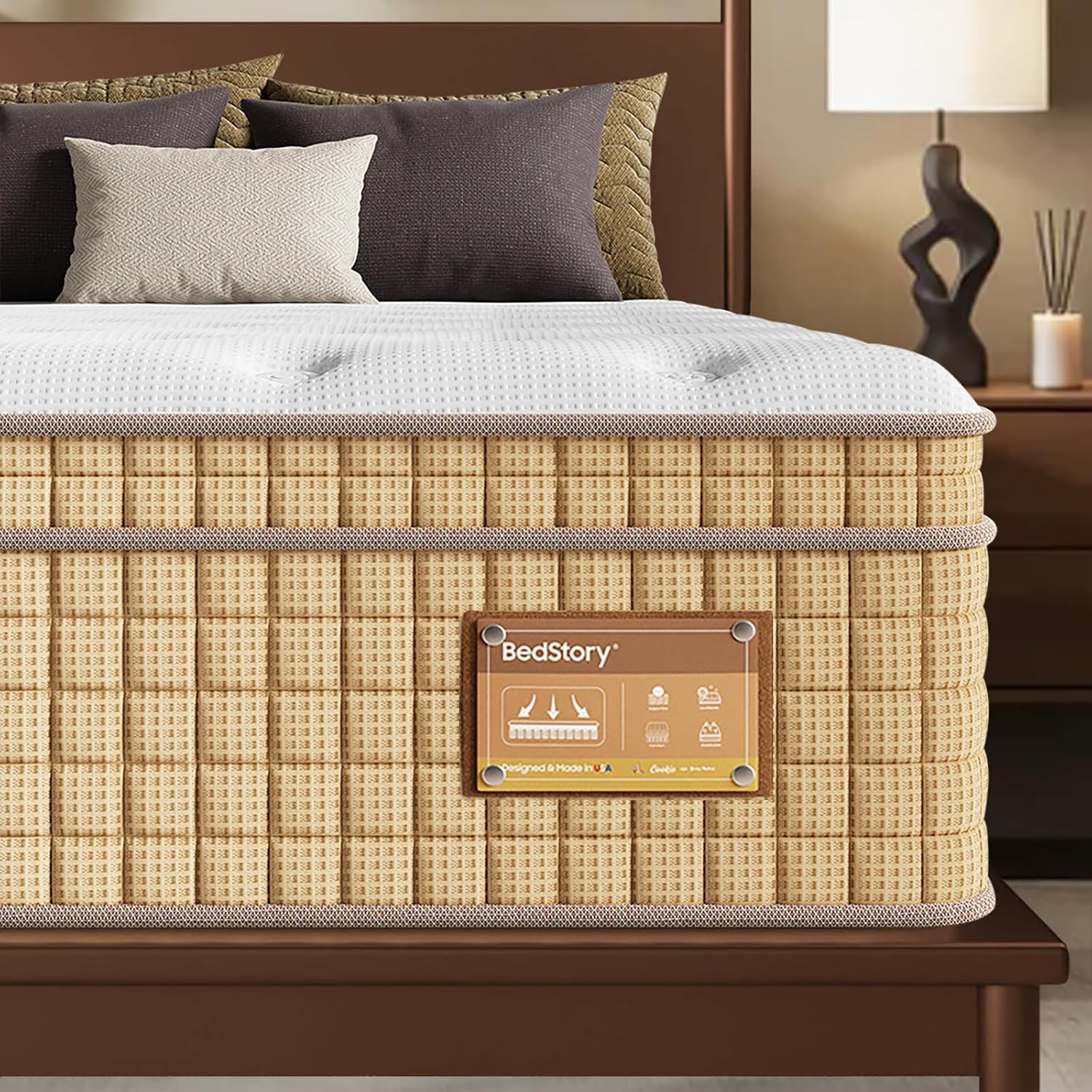
Firm support pick: BedStory Firm Queen Mattress 13 inch, Deep Sleep Hybrid Mattresses in a Box, Zoned Lumbar Support for & Back Pain Relief, Made in USA, CertiPUR-US Certified, 365 Night Trial, 10-Year Warranty
 Visit on Amazon →
This is the one I point at when a patient tells me they sleep on their stomach or their back and they wake up stiff in the lower spine. The 13-inch profile gives the brand room to build a real transition layer instead of putting you eight inches from the coils, and the zoned lumbar support is the feature that matters for the exact complaint I hear most in the clinic.
CertiPUR-US certification is worth naming because it covers what is in the foam, not how it feels. It means the foam has been tested for certain emissions and heavy metals, which matters in a bedroom you keep closed up with the windows down. Made in the USA and a 10-year warranty are the two lines that tell you the brand expects this thing to last, and the 365-night trial is the longest window I have seen on a mattress in this tier, which tells you they are not afraid of you sleeping on it for a year.
Check current Amazon price before you commit, and read the trial terms carefully, because a long trial only helps if the return shipping is covered. The firm feel is the tradeoff. If you sleep on your side and you are narrow through the shoulders, a firm hybrid can load your shoulder joint, and no amount of lumbar support fixes that.
Flaws but not dealbreakers: Firm means firm. Give it the full thirty nights before you judge it, because the comfort layers break in and the surface softens a little in the first two weeks. Stomach and back sleepers will feel the difference immediately. Side sleepers should plan on a softer topper or a different mattress.
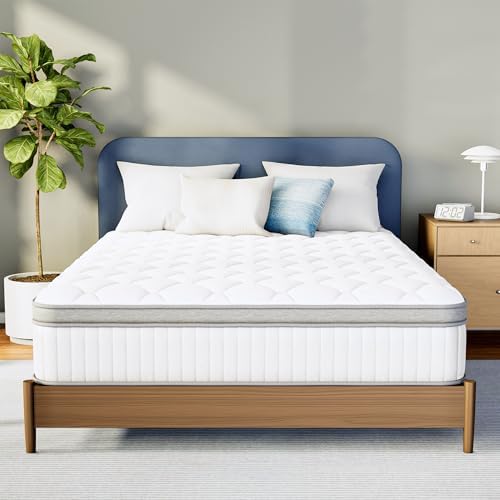
Motion isolation pick: Neo Sleep Queen 12 Inch Hybrid Pocket Spring Mattress, Motion Isolation
 Visit on Amazon →
Motion transfer is the number one reason couples replace a mattress before it wears out. Pocketed springs, where each coil is wrapped in its own fabric pocket, are the design answer, because each coil compresses independently instead of dragging its neighbors along with it. That is the whole point of this unit, and if your partner gets up at five in the morning, it is the spec that will save your sleep.
At 12 inches it is a slightly leaner build than the BedStory, which usually means a thinner comfort layer. For a back sleeper who wants the spine held without a lot of sink, that is often the better call, because less foam between you and the coil unit means less hip drop. Check current Amazon price and compare the two side by side, since the gap between them is smaller than the gap in feel.
The honest caveat: motion isolation and firm lumbar zoning are different goals, and this mattress is built around the first one. If your primary complaint is a stiff lower back and you sleep alone, the zoned support on the BedStory is the more direct answer.
Flaws but not dealbreakers: A 12-inch hybrid with a plush comfort layer will feel softer in the middle than at the edges after a few months of use. Rotate it every three months, head to foot, and the compression evens out.
The step by step
Step one: measure the sag on the mattress you own right now. Put a straight edge across the middle of your current mattress, from head to foot, and measure the gap underneath. If you can slide a finger or two under the straight edge where you sleep, the mattress is done. This is the test that sends most of my patients shopping, and it is the one they skip.
Step two: identify your sleeping position. Stomach sleepers need the firmest surface because their lumbar spine extends if the hips sink. Back sleepers need firm under the middle and a little give at the shoulders. Side sleepers need pressure relief at the shoulder and hip, which usually means a medium hybrid, not a firm one. Get this wrong and no warranty will help you.
Step three: check the coil and foam specs, not the firmness label. Look for a pocketed coil core, a base foam at 1.8 pounds per cubic foot or higher, and a transition layer that is firmer than the top comfort layer. If a listing will not tell you the foam density, that is an answer in itself.
Step four: get the foundation right before the mattress arrives. A hybrid needs a solid, ventilated base. Slats no more than three inches apart, or a box foundation designed for a hybrid. A sagging foundation will kill a good mattress faster than anything else, and it voids warranties more often than people realize.
Step five: confirm the trial and the return terms in writing. A 365-night trial is only generous if returns are free and the mattress does not have to be donated in original packaging. Read the fine print before delivery day, not after night forty.
Step six: give it thirty nights. New foam softens and the coil unit settles. Night one tells you almost nothing. I will not form an opinion on a mattress before night thirty, and neither should you.
Step seven: rotate, do not flip. Head to foot, every three months for the first year, then every six. Most hybrids are built with a one-sided comfort layer and flipping them ruins the structure.
Step eight: fix your pillow before you blame the mattress. A firm hybrid raises your shoulders, which means a thick pillow now pushes your neck into flexion. Back and stomach sleepers on a firm mattress usually need a thinner pillow than they are using. This is the cheapest fix in the entire guide and it solves more morning neck pain than any purchase.
What this will not fix
A mattress is not a treatment. If your pain travels down your leg, wakes you at night, or shows up before you ever get into bed, that is a conversation with a clinician, not a shopping cart. I say that as someone who treats this for a living.
Firm is also not a virtue by itself. A mattress that is too firm for your body weight creates pressure points at the shoulders and hips, and your nervous system responds by making you change position all night, which is its own kind of bad sleep. The right firmness is the one that keeps your spine neutral while letting your joints rest.
And cooling claims deserve one more mention. A gel-infused layer moves heat a little. It does not cool you. If you sleep hot, the airflow through a pocketed coil core does more for you than any phase-change material on the market, and a breathable cotton sheet does more than both.
What this all costs
The math is simple and it is not about the sticker. Take whatever you pay today and divide it by the nights you expect to keep the mattress. A hybrid at this tier with a 10-year warranty should give you seven good years, which is roughly 2,555 nights. A cheap mattress that sags in year two costs more per night than a well-built hybrid costs per night over seven years, and it costs you two years of sleep on top of that.
The accessories are where the budget leaks. A proper foundation, a mattress protector, and the right pillow together run a fraction of the mattress itself, and skipping the foundation is how people end up back in this article in three years.
Check current Amazon price on both units, compare the zoning against the motion isolation, and pick the one that matches how you actually sleep. Then give it thirty nights and a pressure map of your own, even if that map is just how you feel at 6 a.m.
Your spine does not care what the label says. It cares whether it is held in neutral. Buy the mattress that does that.