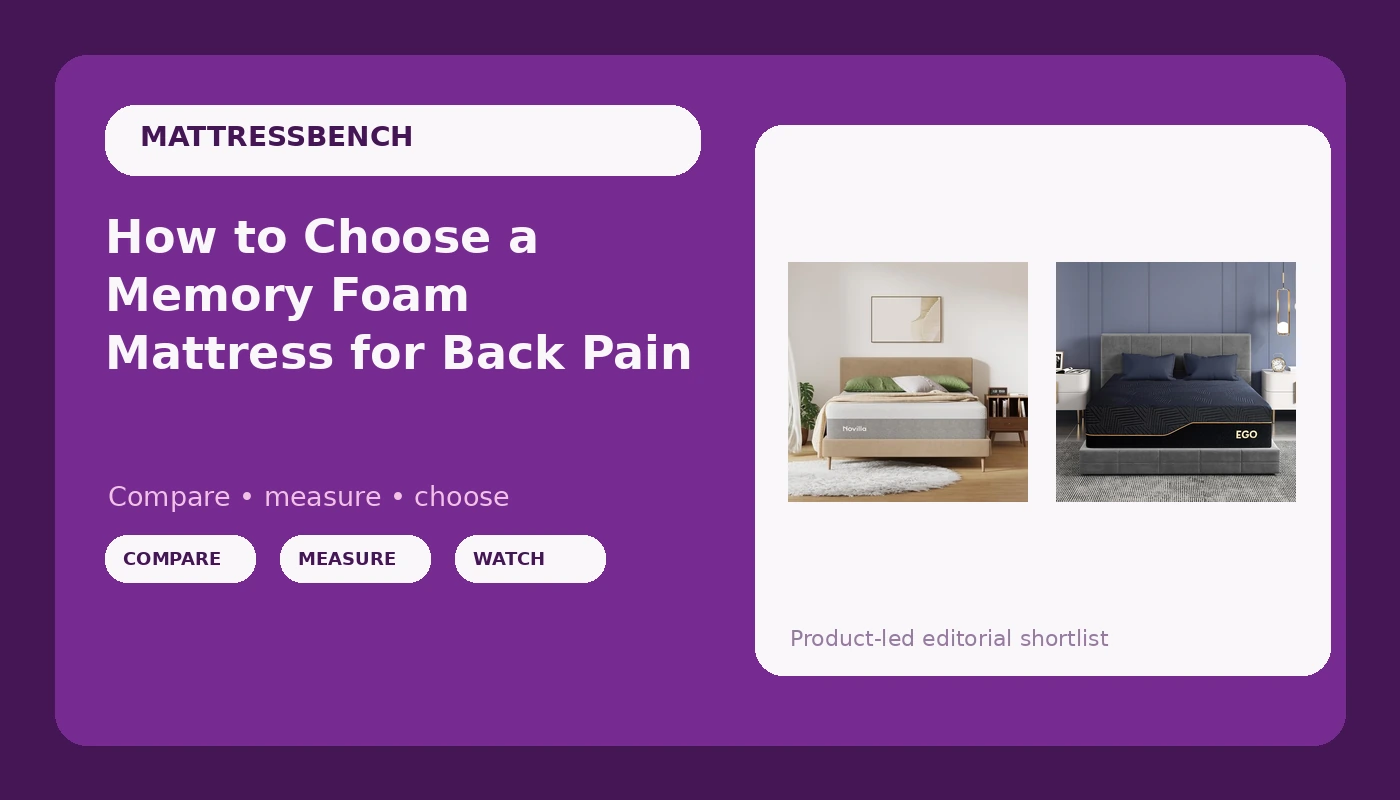
Most people shopping for a memory foam mattress for back pain start with the wrong question. They ask which brand, which firmness, which one has the best reviews. The question that actually decides whether your back hurts at 3 a.m. is simpler: does this bed hold your spine where it already wants to be, or does it let your hips sink until your lumbar spine spends the whole night doing the work of a support core?
I have been a chiropractor for 18 years in Charlottesville, Virginia. I started reviewing mattresses because too many patients walked in with the same story. The back pain crept in, they blamed the desk chair, the deadlifts, the birthday, and then I asked how old the mattress was and the answer was eleven years. I have slept on more than 60 mattresses in the last decade, logged every one of them, and I test with a pressure map instead of a label.
This is the process I walk patients through in the office, in order, with the two beds I would actually point someone toward at the end. It takes about an hour of thinking, one trip to a store if you want one, and one honest month of sleep to know whether you got it right.
Why you should trust me
I have practiced chiropractic for 18 years, which means I have spent close to 40,000 hours looking at spines and asking people what they sleep on. I keep a logbook of which mattresses my patients stop complaining about, and I update it every year. That logbook is the real credential, not the alphabet soup after my name.
My rules are boring and firm. No recommendation without at least 30 nights of sleep on the bed. No firmness claim without a pressure map reading, which is a sensor pad that shows exactly where your body weight concentrates. And no "this mattress cures back pain" language, ever. I am a chiropractor, I know better than that.
What a mattress can do is stop making a spine worse for eight hours a night. For a lot of people, that is the difference between a stiff morning and a normal one, and that is a real difference, even if it is not a cure.
How I pick and how I test
Every bed that gets a mention from me clears three gates.
The first is a 30-night trial. Foam softens in the first two to three weeks as the cell structure opens up, so night two tells you almost nothing. Night 30 tells you almost everything.
The second is a pressure map. I lie in each sleeping position with the sensor pad under me and look at where the weight stacks up. High pressure at the shoulders and hips means the comfort layer is too thin or too firm. High pressure at the lower back means the bed is letting your midsection sag, which is the classic setup for morning back pain.
The third is a six-month durability check. I look for a divot where I sleep, a soft spot at the edge, and any change in how the surface feels under my hand compared to week one.
The vocabulary that matters is short. Foam density is the weight of the foam per cubic foot, and higher density means the bed holds its shape longer. Edge support is how well the mattress holds you when you sit on the side to put on socks, which you do every single day. Motion transfer is how much your partner's roll at 2 a.m. reaches your side of the bed.
What mattress-related back pain actually looks like
Before you spend anything, check the pattern. Pain that is worst in the morning and eases within an hour of getting up points hard at the bed. Pain that wakes you when you roll over points at the bed too. A visible divot, a ridge down the middle of a two-person bed, or a mattress past the eight-year mark all point the same direction.
There are also signs that have nothing to do with your mattress. Numbness or tingling that runs down a leg, pain that does not ease after you get up and move, or pain that follows an injury needs a clinician, not a shopping cart. A new mattress is not going to fix a disc, and I would rather you hear that from me now than after a return.
The two beds I would point a patient toward
Both of these are memory foam, both are built around a support core with a comfort layer on top, and they sit at different points on the firmness and size spectrum. Neither is a cure. Both are the kind of construction that holds a spine rather than letting it drift.
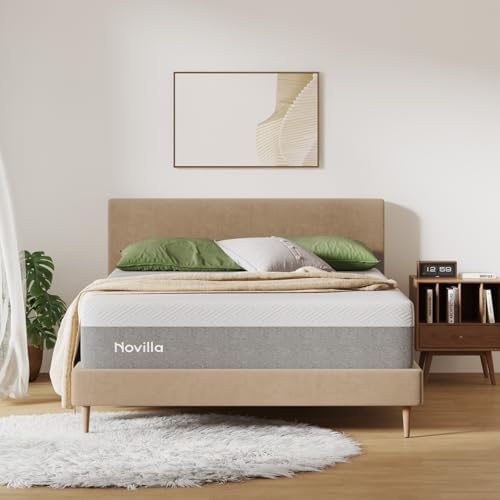
Our pick: Novilla Bliss Queen Size Mattress, 12 Inch Gel Memory Foam Mattress Queen
 Visit on Amazon →
A 12-inch gel memory foam mattress in a queen size is the shape most people should start with. The height matters because it tells you there is a real comfort layer sitting on top of the support core, and that comfort layer is what keeps your shoulder and hip from bottoming out into the firm part of the bed. When a foam mattress is too thin, side sleepers end up with a numb arm and a sore shoulder, and they blame the mattress brand when the problem was the profile.
The gel infusion is worth a sentence of honesty. Gel moves heat around a little better than plain memory foam, and if you sleep warm it is a real improvement over a basic foam bed, but it is not air conditioning. No mattress is air conditioning. If you run hot, pair it with a breathable protector and cotton sheets and expect a modest improvement, not a cold night.
Queen is the right size for most couples and most bedrooms, and it is the size I tell patients to buy if they are between two options. It is also the size where a foam bed holds its shape best, because there is less unsupported span across the middle.
Flaws but not dealbreakers: Memory foam sleeps warmer than a coil bed and it takes a couple of weeks before rolling over stops feeling like a small project. That is the trade for the pressure relief.
Side sleepers, combination sleepers, and anyone replacing a guest room mattress that is older than the last two presidents will get the most out of this one.
Upgrade pick: EGOHOME King 14 inch Memory Foam Mattress for Back Pain Relief Medium Firm
 Visit on Amazon →
This is the larger, taller option, and the height is the part that matters most. Fourteen inches gives you more total foam between your body and the foundation, which is the difference a heavier sleeper feels immediately, because there is simply more material to distribute the load before you reach the support core. In a king, that extra material also spans a wider bed, so a couple gets a surface that stays flatter across the middle.
The "medium firm" in the name is the part I want you to ignore. Every brand's medium is a different bed, and one company's medium is another company's extra firm. Treat the label as a starting point and let your own pressure points be the verdict. Lie on it in your normal position for fifteen minutes. If your shoulder or hip is complaining at minute ten, no label on the box is going to save you.
King size is a commitment beyond the mattress. Measure the room, measure the stairwell, and measure the doorway before you order, because a king foundation that does not fit is a very large thing to return. Deep pocket sheets are a requirement at this height.
Flaws but not dealbreakers: A firmer foam surface is not automatically better for back pain. If you are a committed side sleeper with broad shoulders, a firm bed can push your top shoulder up and twist your spine, which is the opposite of what you wanted. Match the bed to your position, not to the marketing.
Back sleepers, couples who want a firmer shared surface, and anyone who wants a king with enough height to sit on the edge without sinking to the frame will do well here.
The step-by-step
Step one: Audit your sleeping position. Side, back, stomach, or a mix. Side sleepers need a comfort layer that lets the shoulder and hip sink. Back sleepers need the lower back supported, not propped. Stomach sleepers need a firm surface so the pelvis does not drop and crank the lower spine into extension. If you do not know your position, ask your partner, because they know.
Step two: Date the current mattress. Find the law tag. If it is eight years or older, or if you can feel a divot with a flat hand, you are not shopping for an upgrade, you are replacing a worn-out tool.
Step three: Check your foundation before you check the mattress. Slats should be close together, a box spring should be structurally sound, and an adjustable base needs a mattress that is rated for it. A good mattress on a bad foundation sags early, and then the mattress gets the blame.
Step four: Decide the construction. Memory foam gives you pressure relief and quiet motion transfer. Hybrids add coils for airflow and edge support. Latex is bouncier and sleeps cooler. Innersprings are for people who want a traditional feel. Pick the construction first, then the brand.
Step five: Test in your position, not on your back with your shoes on. Showroom naps are useless if you lie flat on your back for ninety seconds. Get in your real position. Fifteen minutes minimum. Bring your own pillow if you can.
Step six: Check the alignment. Have someone look at you from the side. Ear, shoulder, and hip should stack in a straight line. If your hips are lower than your shoulders, the bed is too soft for you. If your waist is hanging in the air, it is too firm.
Step seven: Sit on the edge. If the edge collapses under your weight, you will feel it every morning when you put on your socks, and it is the first place a cheap bed fails.
Step eight: Do the partner test. Roll over while your partner lies still. If they bounce, you will both be awake at 3 a.m.
Step nine: Read the trial and return terms before you buy. Thirty nights minimum. Know who pays return shipping and whether the bed has to be donated. A generous trial you cannot use is not a generous trial.
Step ten: Judge it at night 30, not night 2. Keep a two-line note each morning for the first month. Morning stiffness yes or no. That log will tell you more than any review, including mine.
What the labels actually mean
"Medium" means nothing on its own. It is a marketing word that shifts from brand to brand, and it is the single biggest source of returns in this category.
"Cooling gel" means the foam conducts heat slightly better than plain foam. It does not mean the bed sleeps cold.
"Orthopedic" and "for back pain relief" are marketing phrases, not clinical certifications. There is no certification body handing those out.
"Foam density" is the one label worth chasing. Ask for it. Higher density foam holds its shape longer, and the cheap bed that sags in year two was never actually cheap, because you paid for it twice.
What I left out and why
Hybrids and latex are excellent for people who sleep hot or who want a bouncier surface, and they will get their own guide. Innersprings are the right answer for traditionalists who want a coil feel and strong edge support. Budget foam brands are fine for a guest room that gets used six nights a year and wrong for the bed you sleep on every night.
Toppers, adjustable bases, and pillows all change how a mattress feels, and all of them are downstream of getting the mattress right. Fix the bed first. Then tune the rest.
What this costs over the life of the bed
I am not going to quote you a number, because prices move and a price is the least interesting fact about a mattress. Do the math yourself in nights instead of dollars. A mattress you keep for seven years is roughly 2,555 nights of sleep. Divide whatever you pay by 2,555 and compare that number to a cup of coffee.
Then compare it to the cost of a bad morning. If a mattress buys you two better mornings a month for seven years, the math stops being close.
One last thing. A mattress is a seven to ten year purchase. Buy the one that holds your spine, keep it on a foundation that supports it, rotate it on schedule, and replace it when it sags instead of when it embarrasses you. Your back does not get a day off, and neither does your bed.