Most people with a too-firm mattress assume the answer is a softer bed. They are half right. The other half is support, and support is the part that actually decides whether your back hurts in the morning.
I have been a chiropractor for 18 years in Charlottesville, Virginia. I have lost count of the patients who walked in with low back pain and walked out with the same mattress they bought nine years ago. When I put a pressure pad on those beds, the story repeats: the shoulders and hips light up red, the lower back gets almost no contact, and the spine spends eight hours in a shape it was never built to hold. A mattress topper for back pain can fix the first problem. Nothing fixes the second except a different mattress.
The good news is that "too firm" is the most fixable mattress complaint there is. You do not always need a new bed. Sometimes you need three inches of the right foam between you and a slab. Sometimes you need to admit the slab is finished and start over. This guide walks through how to tell the two apart and how to fix either one in an afternoon.
Why you should trust me
I have slept on more than 60 mattresses in the last decade, and I have put a pressure map on most of them. My testing routine does not change: 30 nights minimum on every bed, a sensor pad to see where the weight actually lands, and a durability check at the six-month mark to catch the mattresses that feel great in week two and sag by month eight. I keep a logbook of which mattresses my patients stop complaining about, and that logbook is less flattering to the industry than you would hope.
I also have boundaries I do not cross. I do not tell anyone a mattress will cure back pain, because I am a chiropractor and I know better. I do not call a mattress firm or soft without a pressure map to back it up. And I do not review anything I have not slept on for at least 30 nights.
How I judge a fix like this
A mattress problem is really two problems wearing one coat. The first is pressure: where your body weight concentrates, and whether the surface spreads it or spikes it. The second is alignment: whether the surface holds your spine in its natural curve or lets it flatten and sag. A mattress can fail either test, and the fixes are different.
Here is what I look at before I recommend anything.
Foam density and thickness. A topper under two inches is a mattress pad, not a fix. Three inches is where you start changing the pressure map. Density matters more than the marketing copy on the box, and a low-density foam that feels wonderful in month one is the same foam that develops a body impression in month twelve.
Zoned construction. A surface that is the same firmness head to toe ignores the fact that your shoulders and your hips carry very different loads. Zoned support means the bed is built to give where you need give and hold where you need hold.
Motion transfer. If you share a bed, the partner test matters. Pocket springs and dense foam both cut motion transfer; a cheap open coil does not.
Certifications and materials. CertiPUR-US certified foam means the foam has been tested for content and emissions, which is a floor, not a trophy, but it is a floor worth having. Fiberglass-free construction matters because you do not want glass fibers in your bedroom air.
The return policy. A mattress is a seven to ten year purchase. If you cannot sleep on it for a month and send it back, you are guessing.
That is the checklist. Two products below are the ones I point patients toward, one for fixing the bed you own and one for replacing the bed that is done.
The fix that does not require a new mattress
If your mattress is structurally sound, meaning no sag in the middle and no body impression where you sleep, then you do not need a new mattress. You need a better interface between your body and the mattress. That is what a topper does, and it is the cheapest spine-friendly change you can make.
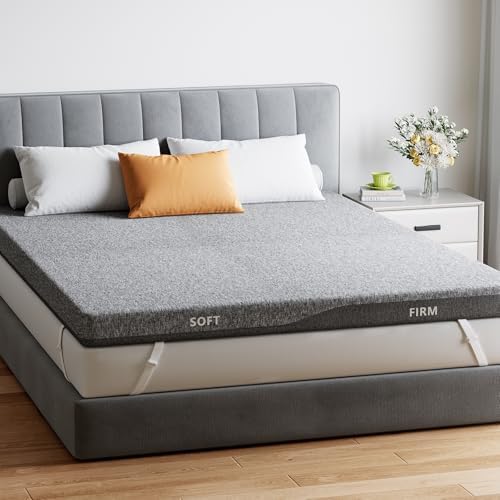
Best for an existing bed: PERLECARE Dual Firmness Mattress Topper King Size, 3 Inch Split King Mattress Topper- Dual Zone Soft and Firm for Pressure Relief & Back Pain, Non-Slip & Removable, CertiPUR-US Certified
 Visit on Amazon →
Three inches of foam with two firmness zones is the most useful shape a topper can take, because it stops pretending that one firmness fits one body. The dual zone build gives you a softer surface where your shoulders and ribcage need to sink and a firmer surface where your hips and lower back need to be held up. If you have ever woken up with a numb arm on a bed that was otherwise fine, that is a pressure problem, and this is the pressure fix.
The split king format is the part I care about most in practice. I have a lot of couples where one partner wants a soft bed and the other wants something closer to a board, and for years the only honest advice was "buy two mattresses." A split topper lets each side run its own firmness on the same bed, which is a real solution instead of a compromise that leaves both people unhappy.
The practical details are right too. The non-slip bottom keeps it from sliding when you sit down or roll over, which sounds minor until you have spent a month pushing a topper back into place every morning. The removable cover is washable, which matters more than people admit, because foam collects sweat and dust over time. It is CertiPUR-US certified, so the foam has been tested for content and emissions.
A topper is not a repair, and I want to be direct about that. If your mattress sags in the middle, a topper will follow the sag and you will have spent money on a nicer version of the same problem. If the foundation under the mattress flexes or the slats are spaced too far apart, fix that first. Three inches of foam also changes the height of your bed, so check that your fitted sheets still fit, and expect to want a deeper pocket sheet if yours are tight.
Check current Amazon price on the listing, and confirm the size you need before ordering, because king, split king, and queen are not interchangeable.
Flaws but not dealbreakers: Any foam topper sleeps warmer than a bare mattress. The dual firmness only helps if you actually orient it the way you need, so read the setup instructions once and mark the soft side.
Anyone with a sound mattress that is simply too hard, and any couple who cannot agree on firmness, should start here.
When the bed itself is the problem
Some mattresses cannot be saved. If you can see a body impression, if a straight edge laid across the middle shows a dip, if the bed is eight years old or older, or if you wake up with pain that fades within an hour of getting up, the surface is the problem and a topper is money spent on top of a dead bed.
That is when a hybrid makes sense. A hybrid puts memory foam over pocket springs, which is a combination that gives you pressure relief from the foam and real structural support from the coils underneath. A foam-only mattress can hold alignment, but it depends entirely on foam density, and low-density foam is where the two-year sag stories come from.
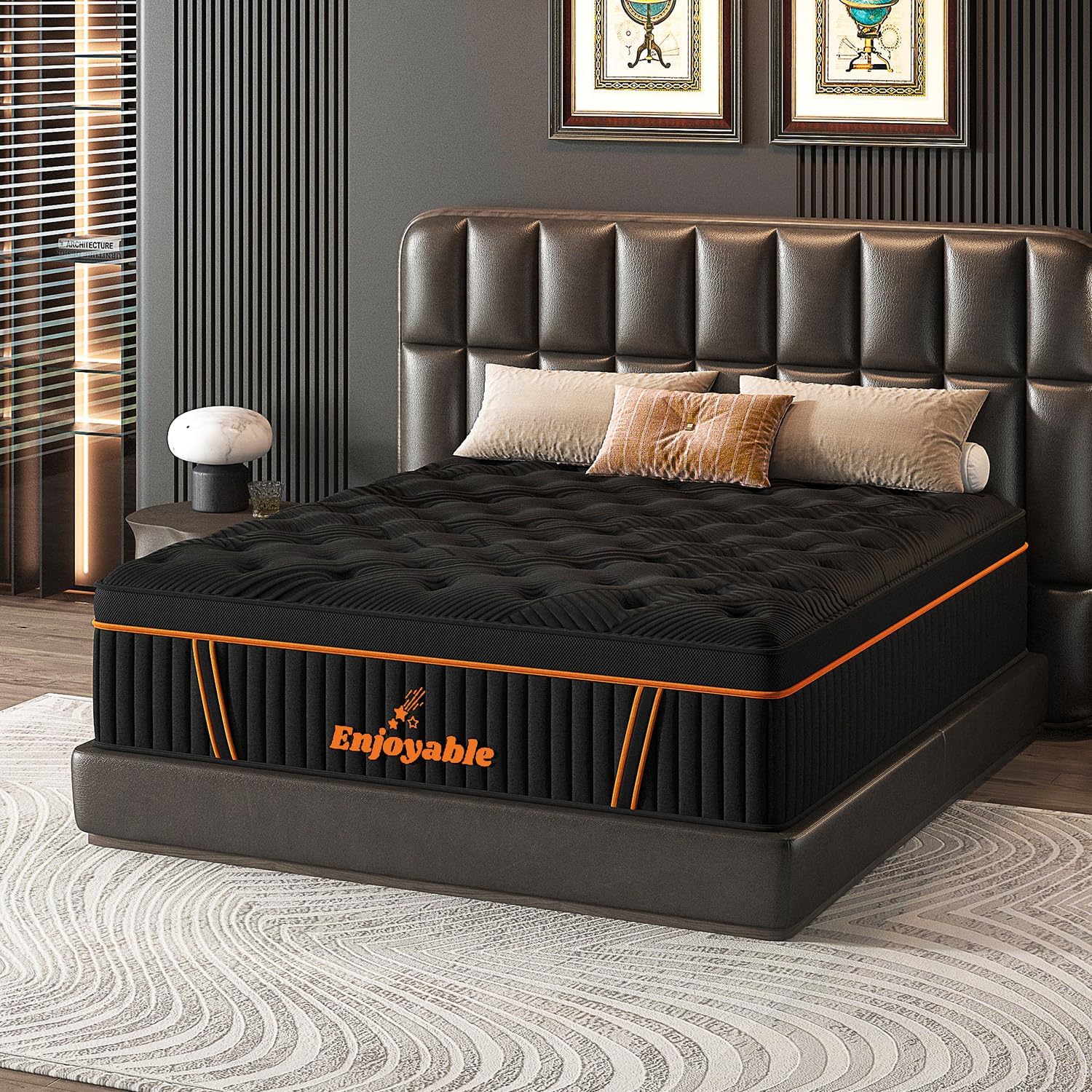
Best for starting over: Queen Mattress 14 Inch - Hybrid Queen Size Bed in a Box with Memory Foam & Pocket Springs, Medium Firm Cool Sleep Mattress with Zoned Support, Motion Isolation, CertiPUR-US Certified, Fiberglass-Free
 Visit on Amazon →
This is a 14 inch hybrid queen, which is a sensible thickness for a bed in a box. The memory foam layer handles pressure at the shoulders and hips, the pocket springs handle support and airflow underneath, and the zoned construction is the detail I actually want to see, because it means the middle of the bed is built to hold your lumbar curve rather than let it flatten.
Pocket springs also give you motion isolation, which is the partner test. On an open coil mattress, your partner rolling over at 2 a.m. wakes you up. On pocket coils, each spring moves on its own, so movement stays local. For anyone who shares a bed with a restless sleeper, this is not a luxury feature, it is the reason you sleep through the night.
Two details I flag for patients. First, the mattress is described as medium firm, and "medium" is a brand label, not a standard. Every brand's medium is different, so treat it as a starting point and not a promise. Second, it is fiberglass-free and CertiPUR-US certified, which are both things I want in a bed that will be in your bedroom for a decade.
On cooling: I will be honest with you. "Cool sleep" mattresses are the most overhyped category in this industry, and a gel layer is not air conditioning. What actually keeps a bed from turning into a heat trap is airflow, and pocket springs with space between them move air in a way that a solid block of foam cannot. That is a real advantage, but it is not the same thing as a chilled mattress, and no manufacturer should tell you otherwise.
A bed in a box needs time. Give it 24 to 72 hours to fully expand, and give yourself two to four weeks to adjust to it. If you are coming off a 12-year-old bed, the first week on a supportive mattress can feel strange, because your body has been sleeping around the damage for years.
Check current Amazon price on the listing and measure your frame before you order, because a 14 inch queen needs a frame that can take the height.
Flaws but not dealbreakers: The medium firm label means the feel may land firmer or softer than you expect, and it is not an adjustable bed. If you need to change the angle of the head or feet, that is a different purchase.
Anyone replacing a sagging or decade-old mattress, and anyone who shares a bed and wants the motion transfer handled, should look here.
The actual fix, step by step
This is the part you came for. It works whether you are patching a firm mattress or replacing one.
Step one: Figure out whether you have a pressure problem or an alignment problem. Lie on your back and slide a flat hand under your lower back. If your hand slides through with room to spare, the bed is not filling your lumbar curve and the problem is alignment. If your hand has to be forced in, the bed is hammocking and the problem is softness. If your hand fits snugly with light contact, the support is roughly where it should be and the complaint is probably pressure at the shoulders or hips.
Step two: Check for sag. Lay a broomstick or a straight edge across the middle of the mattress. If you can see daylight under the middle of the stick, the mattress has a dip. A dip means replace, not patch. Do this on the side you actually sleep on, not the side you never touch.
Step three: Check the foundation before you blame the mattress. Slats spaced more than three inches apart let the mattress sink between them. A broken box spring flexes. A platform that bows under weight is the reason a new mattress still feels wrong. Fix the base first, because it is cheaper than a mattress and it is the most common cause of a bed that feels soft in the wrong places.
Step four: If the mattress is sound and too firm, add a three-inch topper. This is the pressure fix. Orient the soft zone under your shoulders and the firm zone under your hips and lower back. Give it a full night before you adjust it, and expect the first hour to feel different from the rest of the night, because foam warms up and softens as your body heat soaks in.
Step five: If the mattress sags, is old, or has an impression, replace it. Go hybrid with zoned support and pocket coils. Buy from a seller with a real return window. Sleep on it for at least 30 nights before you decide, because a mattress is not a pair of shoes and the first night tells you almost nothing.
Step six: Rotate at three months, then every six months. Rotating is the single cheapest way to extend the life of any mattress, and almost nobody does it. On a hybrid, it keeps the foam layer from developing an impression in one spot. Check your warranty language first, since some warranties require a foundation with a solid surface.
Step seven: Re-check your pressure points at 30 nights. If your morning pain has not changed at all after a month, the surface is not your problem, and it is worth talking to a clinician about what else is going on. A mattress can help a spine, but it cannot treat one.
What did not make this guide
There is a whole category of toppers that does not belong here. The thin egg-crate foam pads that sell for pocket change do one thing well, which is soften a guest bed for a weekend. They do not redistribute pressure, they flatten within months, and they are not a spine fix.
Latex toppers are excellent and I recommend them often, but they are heavy, they are expensive, and they do not come in the dual firmness format that solves the couple problem. If you already know you want the resilience of latex, that is a different article.
Pillow-top mattresses are the wrong way to solve a firmness problem, because the pillow top is sewn into the mattress and cannot be replaced when it compresses. When that top layer dies in year four, you are buying a whole mattress instead of a topper.
Air beds and adjustable bases are both legitimate tools, but they answer questions about adjustability and elevation, not about the pressure and alignment problems this guide is about.
And the mattresses that are marketed on cooling alone? Skip them. Ask about coil construction, foam density, and zoned support instead. Those are the things you will still feel in year five.
What this actually costs
Do the math yourself, because it is the most useful calculation in the category. Take the listing price and divide it by 2,555, which is the number of nights in seven years. That is your cost per night, and it is the only number that matters. A cheap mattress that sags in year two costs more per night than a better one that lasts eight years, and it costs you sleep in the meantime.
The topper route is the smaller spend, and it is the right call when the mattress underneath is sound. The replacement route is the larger spend, and it is the right call when the bed has failed structurally. Buying a topper for a sagging mattress is the one combination that wastes money, because you end up with a nicer surface on top of the same dip.
Either way, check current Amazon price before you commit, confirm the size against your frame, and read the return terms. That is the whole decision.
Your spine does not care what the label says. It cares whether the surface holds the curve and spreads the load. Fix that, and you stop waking up at 4 a.m. hunting for a position that does not hurt. That is the job, and it is worth doing once.