Most of the patients who walk into my office in Charlottesville with a sore lower back are not sleeping on a broken mattress. They are sleeping on a mattress that quietly stopped fitting them. The cheapest fix I know is a mattress topper for back pain, and I recommend one far more often than I recommend a new bed.
I have been a chiropractor for 18 years. I started reviewing mattresses because I got tired of adjusting the same spines every three weeks, and because a shocking number of those spines traced back to a ten-year-old bed with a crater in the middle. I have slept on more than 60 mattresses in the last decade. Every one of them got a 30-night trial, a pressure map with a sensor pad, and a six-month durability check.
Here is the short version of what I have learned. A topper fixes comfort. It cannot fix support. If the mattress under your hips still holds your spine in alignment, a topper is a smart purchase. If that mattress sags, no topper on earth will save it, and you are shopping for a new bed.
This guide walks both paths: how to tell which problem you have, and how to set up either fix so your back stops complaining.
Why you should trust me
I have been a chiropractor for 18 years, and I keep a logbook of which mattresses my patients stop complaining about. That logbook is more useful than any showroom, and it is why I test the way I do.
Every mattress I review gets the same treatment: a 30-night trial, a pressure-point check with a sensor pad, and a durability assessment after six months of real use. I do not review anything I have not slept on. I do not make firmness claims without a pressure map. And I do not tell anyone a bed will cure their back pain, because I know better than that. A mattress can hold your spine in neutral. Your back does the rest.
The other thing 18 years of practice taught me: "medium" means nothing. Every brand's medium is a different number, and the label on the box tells you nothing about what happens under your hip. I test with the pressure map, not the label.
How I picked and how I tested
Two products carry this guide, and they cover the two paths. The topper is the comfort fix. The mattress is the support fix for anyone who has already lost the bed underneath them.
I looked for four things in both. Foam density, because density decides whether a surface is still doing its job in year three. Certification, because foam that off-gasses in your bedroom is not a bargain at any price. Zone placement, because a topper that is uniformly soft lets your hips sink while your shoulders stay high, which is how you wake up with a knot between your shoulder blades. And honest construction claims, because the cooling language on most packaging is marketing, not physics.
The pressure map is the honest test. A sensor pad shows where your body weight concentrates. If the map shows a hot spot under your hip and another under your shoulder, the surface is too firm for a side sleeper. If it shows a broad, even spread with no concentration, the surface is doing its job. That is the test. Not the label, not the price, not the number of gel beads in the cover.
When a topper is the fix, and when it is not
Direct answer first: a topper helps when your mattress is too firm, too thin, or too old to feel good but still flat and structurally sound. It does not help when the mattress has lost its support layer.
Three checks, about two minutes:
The broomstick check. Lay a broom handle across the middle of the bed. If you can see daylight between the handle and the mattress surface, you have a crater. A topper will follow that crater down. Replace the mattress.
The side-lying check. Lie on your side the way you actually sleep. Have someone look at your spine from behind, or take a photo. Your ear, shoulder, and hip should form a line. If your hip drops below your shoulder, the surface is too soft. If your shoulder is jammed up and your waist is floating, the surface is too firm, and a topper is exactly the right tool.
The edge check. Sit on the edge of the bed. If the edge collapses under you, the support layer is already tired, and a topper does not fix tired.
If you passed the broomstick check and failed the side-lying check, keep reading. That is the topper case.
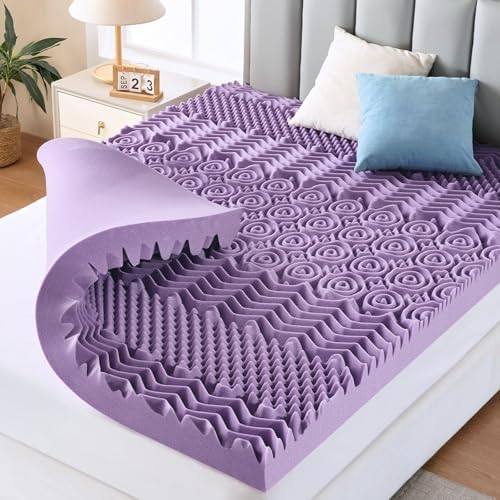
Our pick: MUXHOMO 3 Inch 7-Zone Queen Mattress Topper, Egg Crate Memory Foam Mattress Topper Queen Size for Back Pain, Lavender Gel Infused Bed Pad, CertiPUR-US and Oeko-TEX Certification (60"×80")
 Visit on Amazon →
Three inches is the thickness I recommend when someone needs a real comfort change and not a placebo. Anything under two inches mostly just makes the bed feel different. Three inches changes where your weight lands.
The 7-zone egg crate profile is the part that matters for back pain. Peaks and valleys give the foam room to compress where you are heavy and stay put where you are light, which is roughly the opposite of what a flat slab of memory foam does. The zones are meant to put softer foam under the shoulders and hips and firmer foam under the lower back. That is the right idea for a side sleeper, and it is the reason this one earns the pick over a flat two-inch pad.
CertiPUR-US and Oeko-TEX certification are on the label, and those two matter more than the lavender. The gel infusion and the scent are comfort features. They are not air conditioning. Do not buy this expecting a cool bed. Buy it because the foam is certified, the profile is zoned, and three inches is enough to change a pressure map.
Flaws but not dealbreakers: Egg crate foam takes a set over time, and three inches of it will flatten under a heavy sleeper faster than a dense flat slab will. Expect to replace it before you replace the mattress under it. Queen sizing here is 60 by 80 inches, so measure if your bed is anything unusual.
Anyone whose mattress is flat but too firm, especially a side sleeper with shoulder or hip pressure, should start here.
Check current Amazon price before you commit.
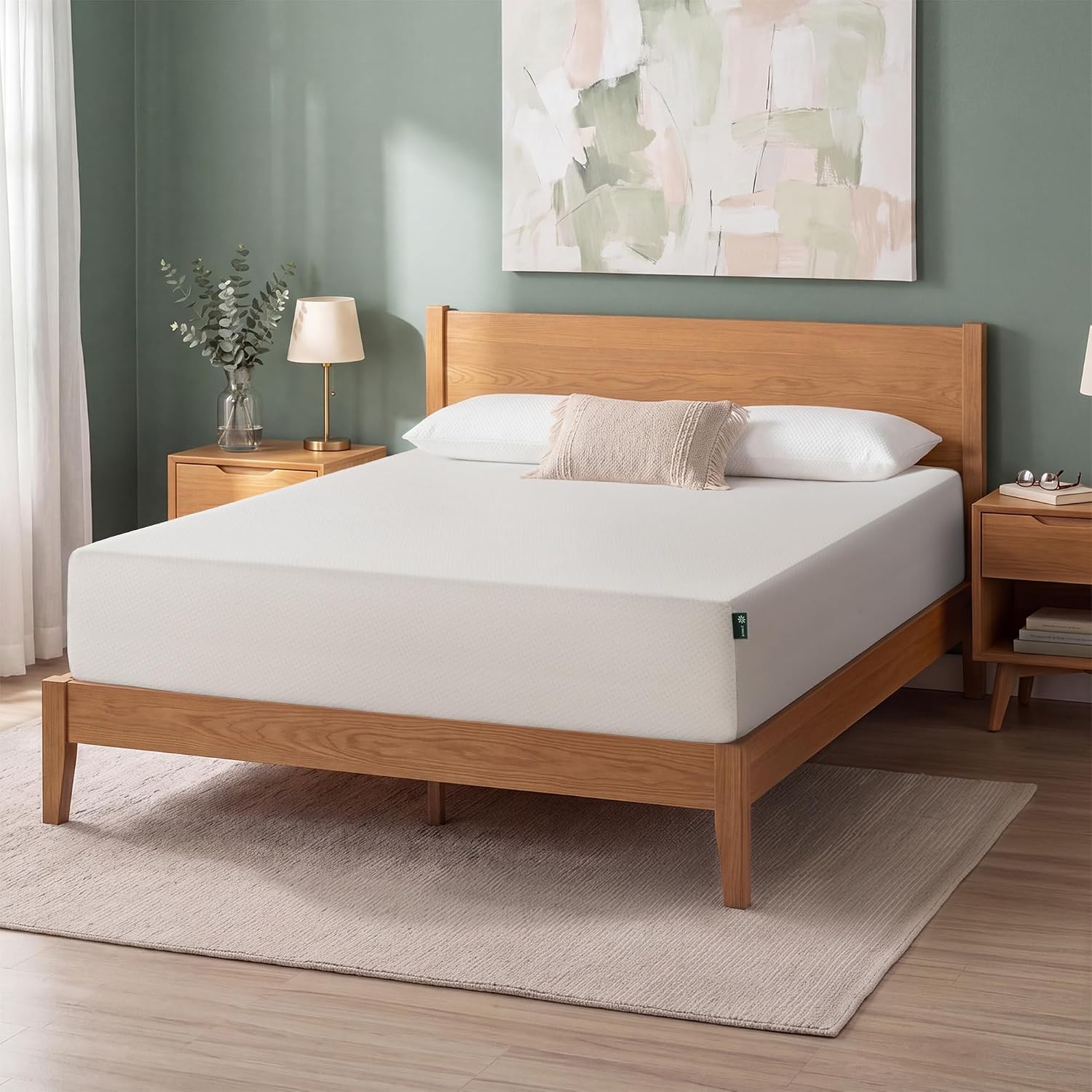
Budget pick: Zinus 12 Inch Queen Green Tea Memory Foam Mattress, Medium Firm Feel
 Visit on Amazon →
If the broomstick check failed, this is the mattress I point budget shoppers toward, with one honest caveat up front: it is a budget mattress. I say that as someone who thinks budget is fine for a guest room or a starter apartment, and who would rather you replace a crater now than sleep on it for another three years.
What it has going for it: a 12-inch profile, which means a real support core under the memory foam instead of a thin slab with a cover. Green tea and charcoal are infused into the foam, which is the brand's answer to odor and moisture. The medium firm feel sits in the middle of the range, and the memory foam top layer is what gives you pressure relief that a cheap innerspring will not.
What it does not have: edge support worth sitting on, or the density of a mattress that still feels new in year eight. Treat it as a seven-year purchase at best, and rotate it every few months.
Flaws but not dealbreakers: Memory foam sleeps warm, and a green tea infusion does not change that. If you run hot, add a breathable cotton pad over it and skip the gel marketing.
Anyone furnishing a first apartment, a guest room, or a rental where a premium mattress makes no sense should look here first.
Check current Amazon price before you commit.
The actual setup workflow
Step one: strip the bed and check the foundation. Slats more than three inches apart, a sagging box spring, or a frame with a broken center rail will make any mattress feel bad. Fix that before you spend money on foam.
Step two: rotate the mattress. Head to foot, once every three months for the first year, then twice a year after that. If you cannot remember the last time you did it, do it today.
Step three: let the topper breathe. Unpack it, lay it flat on a spare bed or the floor, and give it 24 to 48 hours. Memory foam ships compressed. Put it on the bed the minute it comes out of the box and you will sleep on a lumpy rectangle and blame the topper.
Step four: topper first, then the sheet over both. A topper under a too-tight fitted sheet will slide all night. If your sheets will not stretch over three extra inches, buy deep-pocket sheets rather than skipping the topper.
Step five: give it 30 nights. This is my rule for every mattress, and it applies to toppers. The first three nights tell you almost nothing because your body is still mapping the old surface. Judge it at night 30, not night two.
Step six: check your pillow height. This is the step everyone skips. Add three inches under your shoulders and your old pillow is now too thin. Side sleepers usually need a pillow that fills the gap between the neck and the mattress. If your neck starts aching a week after the topper arrives, the pillow is the culprit, not the foam.
Step seven: rotate the topper too. Egg crate foam takes a set. Flip and rotate it every couple of months.
Step eight: fix the frame before you blame the bed again. A center support leg that never touches the floor is a common cause of a bed that feels soft in the middle.
Three mistakes that undo the fix
Buying a topper to fix a sag. This is the most common one. If the middle of the bed is a valley, the topper follows the valley down, and you have spent money to sleep in the same hole with softer edges.
Buying a one-inch topper. One inch of foam is a mattress pad with ambition. It changes texture, not support.
Believing the cooling label. Gel beads in foam do not move heat the way airflow does. A gel-infused topper can still sleep warm. If heat is your problem, a breathable cotton cover over the topper does more than any gel claim on a box.
The competition and why it lost
The other topper categories I get asked about, and where they fall short for this job:
Latex toppers. Latex is more resilient, sleeps cooler than memory foam, and holds up longer. It is also heavier and more expensive, and it does not contour the way memory foam does. For a back sleeper who wants a firmer surface with a little give, latex is a fine choice. For a side sleeper chasing pressure relief, memory foam wins.
Down and fiberfill toppers. Soft, breathable, and inexpensive. They also compress to almost nothing under a hip, which means they change how the bed feels and not how it supports you. Skip them if the goal is back pain.
Flat memory foam pads. A two-inch flat pad can take the edge off a hard mattress. It cannot zone anything. Your hips and your shoulders get the same foam, which is exactly the problem with a too-firm bed in the first place.
Mattress pads and protectors. A waterproof protector is a good idea for a completely different reason. It is not a comfort product, so do not confuse the two.
Hybrid mattresses. If you are replacing the bed and you want coils plus foam, that is a different article and a different budget. For this guide, the question is whether you can fix what you already own.
What this all costs
The math is simple even without numbers on the page. A topper costs a fraction of a mattress. If your bed passed the broomstick check, you are spending a small amount to extend a mattress you already own, and that is the best value in the sleep industry.
If your bed failed the broomstick check, a topper is money wasted on top of a bed you are going to replace anyway. Buy the mattress first. Add the topper later if the new one turns out too firm, which is a real possibility with any medium firm foam bed.
Over seven years, the cost per night of a mattress is small. The cost of sleeping on a crater for another three years is a sore back, a bad morning, and a chiropractor bill you did not plan for. That is the comparison that matters.
The bottom line
Diagnose before you buy. Broomstick check, side-lying check, edge check. If the mattress is flat and too firm, the topper is the fix, and a zoned three-inch egg crate profile is the right shape for a side sleeper. If the mattress is sagging, replace it, and a 12-inch memory foam mattress in the medium firm range is a reasonable place to start on a budget.
Then give it 30 nights. That is the rule I give every patient, and it has never once been wrong.