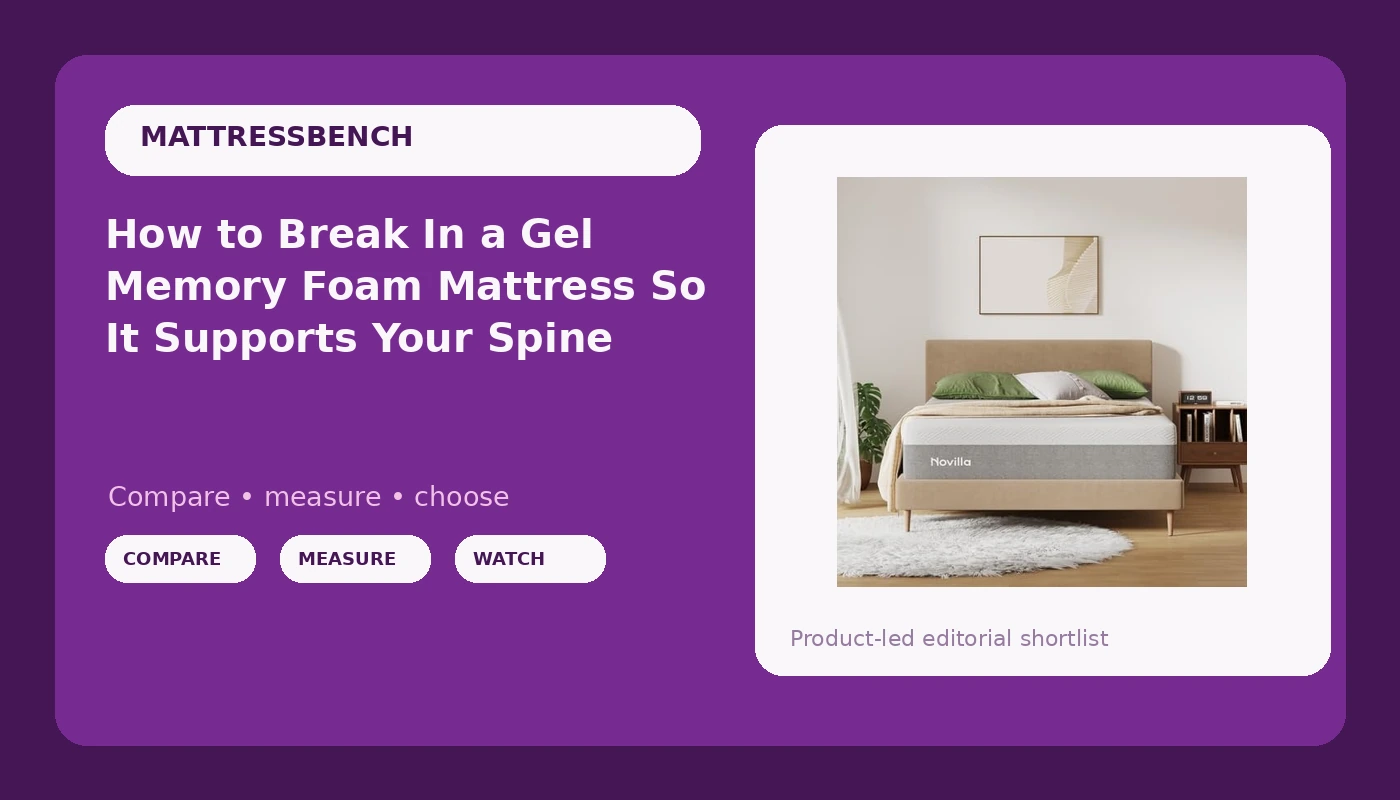
Most gel memory foam mattress complaints I hear in my office are not foam complaints. They are setup complaints. A 12 inch queen shows up vacuum sealed in a box the size of a mini fridge, you cut the plastic, it unfolds like a pastry, and you sleep on it that same night on whatever frame was already in the room. Two weeks later your lower back starts talking, and the mattress gets blamed for a problem that started with a slat spacing and a night-one verdict.
I am a chiropractor in Charlottesville, Virginia. I have spent 18 years treating spines, and for the last decade I have also reviewed mattresses, more than 60 of them, each one slept on for at least 30 nights with a pressure map and an edge support check. Here is the part that matters to you: the patients whose morning back pain improved after a new bed almost never bought a better mattress than the ones who kept hurting. They set the bed up correctly, and they gave the foam time to do its job.
This guide is that setup. It is not a ranking, and it is not a cure for anything. I am a chiropractor, and I know better than to tell you a piece of foam treats a spine. What I can tell you is the exact sequence I walk patients through, and it works on any gel memory foam mattress. I have written it around one specific 12 inch queen, because that is the shape and price band most people actually buy.
Why you should trust me
Eighteen years of clinical practice means I have seen a few thousand backs and heard a few thousand mattress stories. The last ten years of reviewing means I have run the same protocol on every bed I write about: a 30-night trial, a pressure map with a sensor pad to see where weight concentrates, an edge support test, and a durability check at six months.
My rules are simple and they are public. No review without at least 30 nights on the bed. No firmness claim without a pressure map. No "this cures back pain" language, because that is not how spines work. I keep a logbook of which mattresses my patients stop complaining about, and it is a shorter list than the marketing would have you believe.
One honest note before we start: I have not logged 30 nights on the specific queen below, so I am not scoring it. This is a setup guide, not a scored review, and the steps apply to whatever gel memory foam bed is in your bedroom.
What this guide is and what it is not
It is not a "which mattress should I buy" article. You either already have the bed, or you already ordered it, and the box is in the hallway.
It is also not a promise that a budget foam bed will outlast a premium one. Foam density is the number that decides lifespan, and density is the first thing budget beds give up. Higher density foam weighs more per cubic foot, holds its shape longer, and costs more to make. That is the honest trade. What setup does is make sure you get every night the foam is capable of giving you, instead of burning through the good years on a bad foundation.
Before the box arrives: test the foundation
The foundation is where most of this goes wrong, and it is the one thing you can fix before the mattress shows up.
A gel memory foam mattress wants a flat, rigid, evenly supported surface. That means a platform bed, a slatted frame with slats close together, or an adjustable base. A slatted frame with wide gaps lets the foam sag into the gaps, and once foam sags, it does not come back.
The old box spring in the guest room is usually the wrong answer. A box spring is designed to flex, and flex under memory foam means the foam takes the load instead of the springs. If the torsion bar in the middle is already sagging, the bed will have a valley in the center within a year, no matter how good the foam is.
Three things to check before the delivery:
- Press down on the center of the foundation with your palm. If it gives more than the edges, the foundation is already tired.
- Count the slats and look at the gaps. If you can see the floor clearly in wide bands, add a sheet of plywood or a bunkie board before the mattress goes on.
- Make sure the frame does not rock. A wobbly frame feels like a wobbly mattress, and you will blame the wrong thing.
If you are putting the bed on the floor because the frame has not arrived, that is fine for a week, but keep the foam off a cold concrete slab for the long term. Air needs to move under it.
Step by step: setting up and breaking in the foam
Step one: unbox on the frame. Get the rolled mattress onto the foundation first, then cut. Do not run a box cutter deep into the roll, and do not slice through the foam to speed things up. A queen foam roll is heavier and more awkward than it looks, so bring a second person. Cardboard on the floor helps you slide the roll into place without tearing it.
Step two: position it while it is still flat. A compressed mattress is easy to center on the frame. An expanded one is not. Get it square to the foundation before you cut the inner plastic.
Step three: let it expand for at least 24 hours, ideally 48 to 72. Foam expands from the center outward, so the middle will look full long before the corners do. A cold room slows the process, and a warm room speeds it up. If you have any other place to sleep for two nights, take it. Night one on a half-expanded bed is not a real test of anything.
Step four: air it out. New foam has a smell, and that is normal. Open the windows, run a fan, and give the room a couple of days of moving air. It fades. If it does not fade in a week, that is worth a note.
Step five: check the loft and the edges once it is full. Measure from the foundation to the top of the mattress at the center and at each corner after 72 hours. If the corners are still visibly short, log it while it is fresh in your mind, because that is what a warranty conversation would hinge on. Then sit on the edge and watch how far you compress. Edge support is not a marketing feature, it is how you get out of bed at 3 a.m. If the edge collapses under you, plan to sleep more toward the center and keep a chair near the bed if you have mobility issues.
Step six: treat the first 30 nights as a break-in, not a verdict. Foam softens where your body loads it. The bed you sleep on in month two is not the bed you unboxed, and it is not the bed you would be judging on night three. I do not trust a mattress opinion, mine or anyone else's, under 30 nights.
Step seven: rotate head to foot at 30 days, then every three to six months. Rotate, do not flip. Gel memory foam mattresses are built in layers and flipping one puts the support layer on top. Rotating evens out the wear pattern where your hips and shoulders sit, and it is the cheapest way to add years to a foam bed.
Step eight: run your own pressure check. Lie on your back for a few minutes and notice where you sink. Side sleepers should feel the shoulders and hips settle without the waist collapsing. If the shoulders stay high while the hips drop, the mismatch is usually your pillow height, not the mattress. A flat back is the goal, and a pillow that props your head forward will fight the foam all night.
Step nine: protect it and stop changing the surface. A thin waterproof protector is worth it. A three inch topper is not, because it hides the bed you bought and changes every pressure point you just checked. Give it 30 nights bare, then decide.
Step ten: deal with temperature honestly. Memory foam softens as it warms, so a cold bedroom makes any foam bed feel firmer. That is physics, not a defect. If you sleep hot, the fix is airflow in the room and breathable sheets. A gel layer is not air conditioning, and nobody has invented a mattress that cools you down.
The mattress this guide is built around
Everything above applies to any gel memory foam bed, but I wrote it around one specific queen because it is the profile most people end up buying.
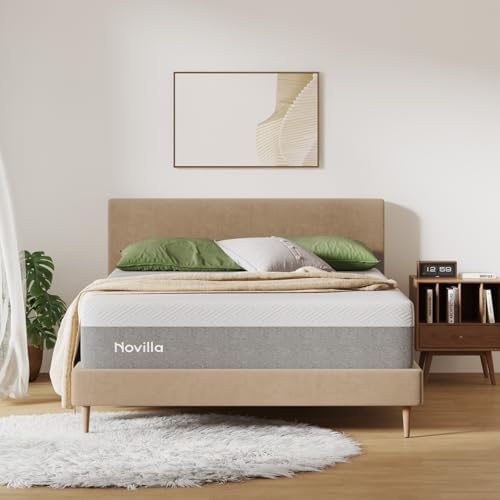
Budget pick: Novilla Bliss Queen Size Mattress, 12 Inch Gel Memory Foam Mattress Queen
 Visit on Amazon →
This is a 12 inch gel memory foam queen in a box, which is the category I see most often in the guest rooms and starter apartments of patients in their twenties and thirties. The 12 inch profile means there is a real amount of foam above the foundation, and that matters for setup: a thicker foam stack has more material to break in, so the expansion window in step three is not optional here, it is the whole game.
At this price band, the trade is density and edge support. That is the category, not a knock on this specific bed. Budget foam beds generally give up some density in at least one layer compared to a premium memory foam build, and the first place you will notice it is how the perimeter holds your weight. That is exactly why step five exists, and why the rotation schedule in step seven matters more on a bed like this than on a heavy premium foam mattress.
What I would do if this box were in my hallway: set it on a rigid platform, give it a full 72 hours before I judged it, sit on the edge and note what happens, then sleep it for 30 nights with a rotation at the end. Read the current reviews on the listing for the long term reports, since those are six and twelve month owners and I am not one of them. Judge the bed by month two, not night one.
Flaws but not dealbreakers: The gel layer is a comfort material, not a cooling system, so do not buy this expecting a cool bed. The edge is the compromise on most foam in this band, so if you sit on the side of your bed every morning, plan for it or add a firm base with a rail.
Anyone furnishing a first apartment, a guest room, or a spare bedroom on a real budget will get the most from this bed. If you have a diagnosed spine condition and need controlled support, talk to your clinician before you buy any mattress, including this one.
The mistakes that make a foam mattress feel wrong
The bed is rarely the problem. These are.
- Judging it on night one or night three. Foam is at its stiffest out of the box and it has not finished expanding. You are sleeping on a fraction of the bed.
- Wide slats or an old box spring. This is the number one cause of a center valley. Foam sags into gaps and does not recover.
- No rotation. Two years of the same hip divot in the same spot is how a bed ends up on the curb in year three.
- A thick topper over new foam. Now you own two mattresses and know how neither of them feels.
- Trusting cooling claims. A gel layer does not move heat out of the room. Room airflow does.
- Flipping it. Layered foam beds are not two sided. Rotate only.
- Sleeping hot and blaming the bed. Change the bedding and the room first, then re-evaluate.
How long until it feels right
Nights one to three are the stiffest the bed will ever be, and if you set it up correctly you may not even be sleeping on it yet. Days four through fourteen are when the foam finishes expanding and starts softening under your load pattern. The 30 night mark is the first honest verdict, and it is also the point where you rotate.
At six months, walk around the bed and press the center. If you can feel a valley where you sleep that does not spring back, that is a durability flag, and it is worth documenting. At year two, take the sheets off and look at the surface with the room light raking across it. Foam problems show up as shadows before they show up as pain.
If you are still uncomfortable at 30 nights, the fix is usually not a new mattress. It is the foundation, the pillow height, or the rotation schedule. Exhaust those before you spend again.
What this all costs
The variables here are the mattress, the foundation, and a protector. The mattress price is on the listing, so check the current Amazon price rather than trusting any number I could quote you today. That figure moves, and a price I write down is stale by the time you read it.
The foundation is where people try to save money and lose it. A rigid platform or a bunkie board is a one time purchase that protects a bed you expect to keep for seven to ten years. Skip it and you replace the mattress early, which means you paid twice.
The protector is cheap insurance, and the rotation schedule is free. Thirty seconds twice a year is the entire maintenance plan.
Run the math the right way. Divide the price of the bed by the number of nights you expect to sleep on it, not by the number of months before you get bored. A bed that sags in year two was never a bargain, no matter what the box cost. A bed that holds its shape through year seven was worth every dollar, even at twice the price.
Set it up right, give the foam its 72 hours, sleep it for 30 nights, and rotate it on schedule. That is the whole job, and it is the difference between owning a mattress and owning a bed that holds your spine.