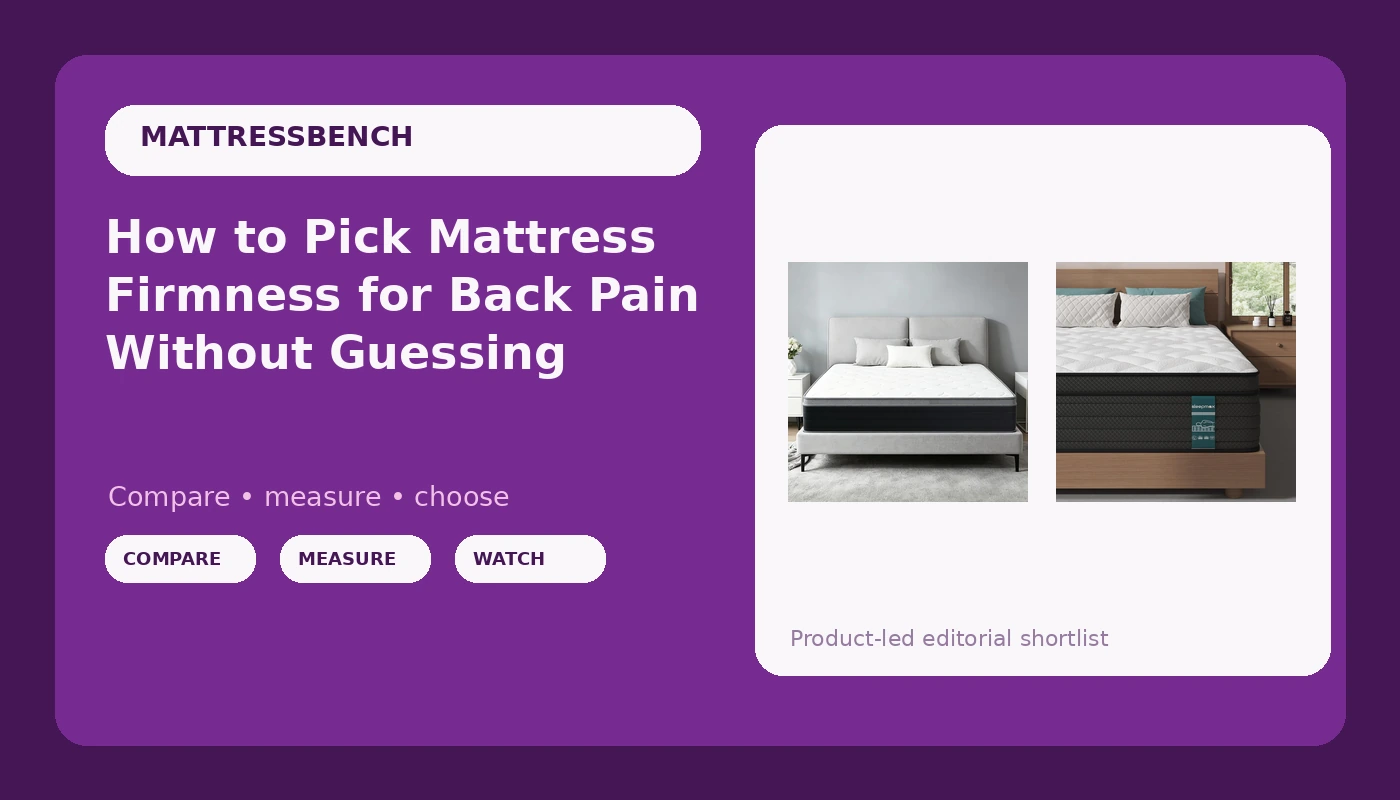
Mattress firmness for back pain is the question I answer most often, and it is the one with the worst answers online. Patients walk into my clinic with a number in their head, usually a seven or an eight on a ten-point scale, and they shop for that number as if it were a standard. It is not. Every brand builds its own scale, and a seven from one company is a four from another. The label is marketing. The support is physics.
Here is the distinction that matters. Firmness is how the surface feels under your hand. Support is whether the mattress holds your spine in neutral while you sleep. You can buy a very firm mattress with terrible support, because foam that has broken down still feels firm and no longer holds anything. You can also buy a soft mattress with excellent support, because a pocket coil core under a plush top layer does the work while the surface stays gentle.
This guide is about choosing between the two ends of that spectrum for the two most common sleepers: the person who needs a firm surface to stop their hips from dropping, and the person who needs a soft, quiet bed that lets their shoulders sink. I will walk through how I judge support, how to test a mattress in fifteen minutes, and which construction to look for at each end.
Why you should trust me
I am Nora. I have been a chiropractor for 18 years in Charlottesville, Virginia, and I started reviewing mattresses because too many patients with back pain traced back to a 10-year-old mattress that had given up years earlier. I have slept on more than 60 mattresses in the last decade. Every one gets the same protocol: a 30-night trial, a pressure-point check with a sensor pad, and a durability assessment after 6 months of use. I keep a logbook of which mattresses my patients stop complaining about.
I do not tell anyone a mattress will cure back pain. I am a chiropractor, I know better. What a mattress can do is hold your spine in neutral so your body can do its own work. That is the whole job.
How I judge support, and how you can too
Three things matter more than the label on the box.
The pressure map. I run a sensor pad under a sleeper for 20 minutes and look at where the weight concentrates. Even distribution across the back, hips, and shoulders means the mattress is doing its job. A hot spot at the hip or the shoulder blade means the surface is fighting the body instead of meeting it. You can approximate this at home with a fifteen-minute lie-down and honest attention to where you feel pressure building.
Spine alignment. On your back, the mattress should fill the curve in your lower back without pushing it flat. On your side, your spine should run roughly straight from the base of your neck to your tailbone. If your hips drop below your shoulders, the middle of the bed is too soft for you. If your shoulder gets pushed up toward your ear, the bed is too firm for you.
Edge support. Sit on the edge of the bed with your feet on the floor. If the edge collapses under you, you will slide toward the middle every night when you get in and out, and you will feel the mattress sag at the perimeter long before the middle wears out. Edge support is the most ignored spec in the industry and one of the most useful.
After that come foam density and motion transfer. Density tells you how long the foam will last, because heavier foam per cubic foot resists breakdown. Motion transfer tells you whether your partner will wake up every time you roll over. Pocket coils isolate movement better than a solid foam block, which is one reason both mattresses below use them.
The firmness label is close to useless
I have measured beds sold as "medium" that landed closer to a brick, and beds sold as "plush" that measured firmer than a competitor's "firm." The label is a marketing decision, not a measurement. So stop shopping for a number.
Shop for two things instead: your sleep position and your body. A 240-pound back sleeper and a 120-pound side sleeper need opposite surfaces, and both of them are told to buy "medium." That is how people end up with the wrong mattress twice.
Start with your sleep position
- Back sleepers need the midsection to stay up. A surface that lets the hips sink puts the lower back into extension all night. This is the group that usually needs more firmness than they think.
- Side sleepers need the shoulder and hip to sink enough to keep the spine straight. Too firm here means pressure at the shoulder and numbness in the arm.
- Stomach sleepers need the hips kept level with the shoulders. A soft bed lets the pelvis drop and the lower back arch.
- Combination sleepers are the hardest case, and they should weight support over surface feel, because a supportive bed is survivable in every position and an unsupportive one is not.
If you share a bed, pick for the person who weighs more. The lighter sleeper can adapt to a slightly firmer surface far more easily than the heavier sleeper can adapt to one that sags under them.
The two directions most people end up choosing
Once you know your position, the decision usually collapses to one of two builds: a firm hybrid with a coil core for the sleeper who needs the surface to stay put, or a softer pocket coil mattress in a box for the sleeper who needs pressure relief and quiet. Here is how those two look in practice.
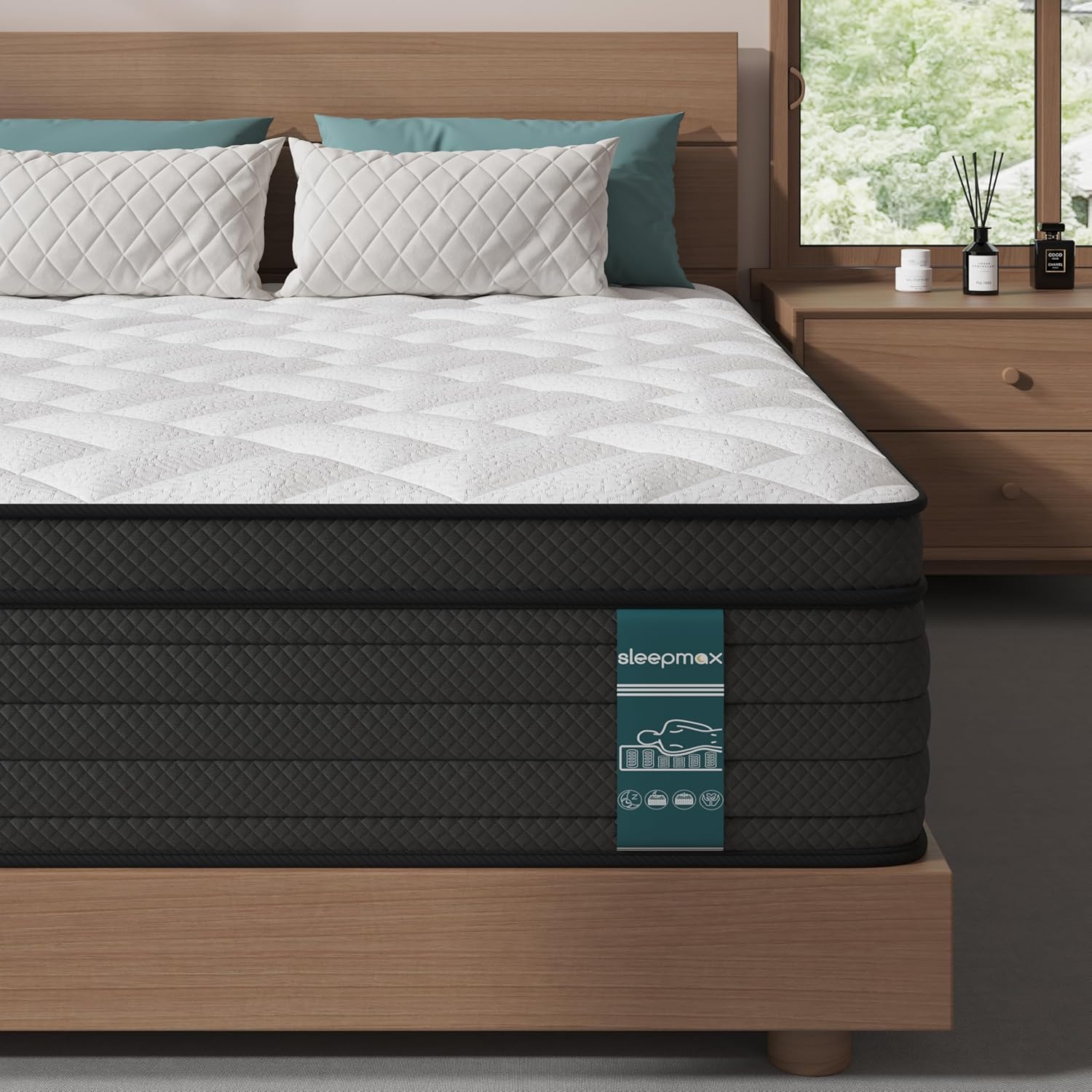
The extra firm pick: Sleepmax Extra Firm Queen Mattress 12 Inch, Hybrid Mattress Pain Relieving
 Visit on Amazon →
This is the bed I point back and stomach sleepers toward when they tell me their hips sink and their lower back aches by morning. It is a 12 inch hybrid, which means a coil core with foam above it, and the extra firm surface is the point. A hybrid at this firmness behaves differently from an all foam extra firm, because the coils push back with a spring rather than a slab. That distinction is why some people who hate firm foam mattresses can sleep on a firm hybrid without complaint.
Check current Amazon price before you commit, because this tier moves.
Who it fits: back sleepers who need the midsection held up, stomach sleepers who need the hips kept level, and heavier sleepers who compress softer beds until the support disappears. If you wake up stiff and you can feel your hips lower than your shoulders when you lie down, this is the direction to go.
Flaws but not dealbreakers: Strict side sleepers with broad shoulders may feel pressure at the shoulder and want a pillow top or a soft topper for the first month. Give any mattress a few weeks before you judge it, because the foams need time to relax and your body needs time to stop guarding.
Anyone who has been told they need a firm bed but keeps buying soft ones should start here.
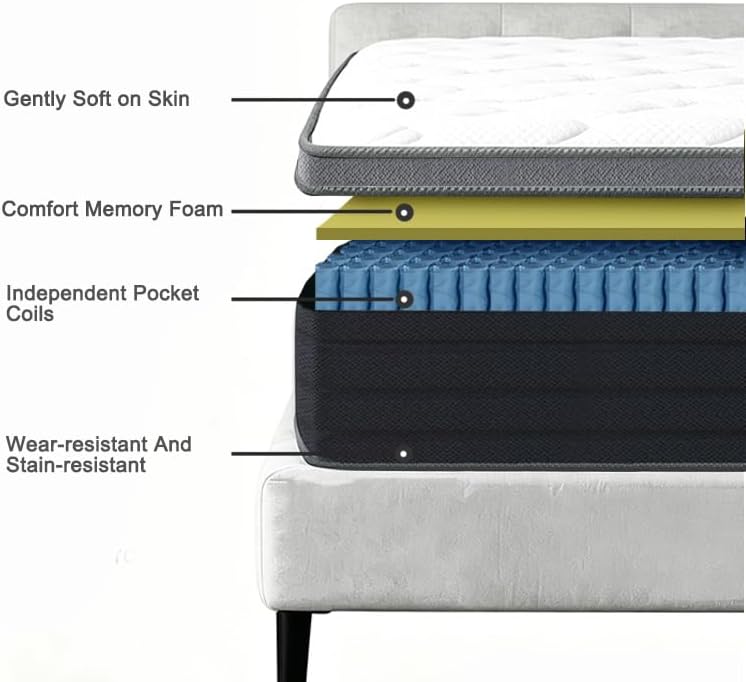
The soft pick: Queen Size Mattress in a Box, 10 Inch 60x80 Inch Pocket Coil Mattress, Soft Hotel Standard Queen Bed Mattress, Quiet Supportive Mattress for Bedroom Guest Room
 Visit on Amazon →
This is the other end of the spectrum, and it is not the enemy of support. It is a 10 inch pocket coil mattress in a box with a soft hotel style top, and the pocket coils are the reason it can be soft without turning into a hammock. Individually wrapped coils compress under the shoulder and hip and stay firm under the lumbar spine, which is exactly what a side sleeper needs. The "quiet" part of the name is the other benefit: pocket coils isolate movement, so a partner rolling over does not send a wave across the bed.
Check current Amazon price to see where it sits today.
Who it fits: side sleepers who need their shoulder to sink, lighter sleepers who never compress a firm mattress enough to activate it, and guest rooms where you do not know who is sleeping there and want a surface most people can tolerate. A soft hotel style bed is a safe default for a room that hosts different bodies.
Flaws but not dealbreakers: If you are a heavier back sleeper who needs the midsection held up, this is the wrong direction, and no topper will fix it. The soft top is a feature, not a flaw, but it is the wrong feature for that sleeper.
Anyone furnishing a guest room or a lighter sleeper's bedroom should look here first.
The five-step process for choosing at home
Step one: Write down your position and your weight range. Not your ideal weight, your actual one. This single sentence eliminates half the catalog.
Step two: Lie down for fifteen minutes, not two. Showroom naps are useless. Fifteen minutes lets the foams warm up and lets your body stop bracing. Bring a book.
Step three: Run the hand test. On your back, slide a flat hand under your lower back. If it slides in easily with room to spare, the middle is too soft for you. If you cannot get it in at all, the bed is too firm.
Step four: Sit on the edge. Both feet on the floor, full weight on the perimeter. If the edge collapses, the bed will feel smaller every night.
Step five: Match the build to the job. Need the hips held up? Look for a firm hybrid with a coil core. Need pressure relief and quiet? Look for a soft pocket coil. Need both? You are a combination sleeper, and you should weight support.
Step six: Check the foundation before you blame the mattress. A soft bed on a sagging box spring or a flexing slat frame will feel like a bad mattress. Slats should be close together, and the center of a queen frame should be supported.
Where people get this wrong
Confusing firm with hard. A firm mattress should push back evenly. A hard one creates pressure points. If your shoulders go numb, you did not buy support, you bought a board.
Buying for the guest room and sleeping on it. If you are the one sleeping there, buy for your spine, not for hypothetical visitors.
Trusting cooling claims. A gel layer is not air conditioning. Airflow comes from the coil core and the room, not from a marketing word on the cover.
Ignoring the trial window. A mattress is a 7 to 10 year purchase. The cheap one that sags in year two was never cheap. Read the return terms before the delivery truck leaves, not after.
What this costs over its life
I am not going to quote you a number, because prices move and any figure in an article is stale by the time you read it. Check current Amazon price on both beds and do the math yourself.
Here is the frame that matters. Divide the price by 2,555 nights, which is seven years. A mattress that lasts seven years and holds your spine in neutral costs you a few cents a night. A mattress that sags in year two and gets replaced costs you the same money twice plus a year of bad sleep. The expensive mattress is the one you buy twice.
The two beds here sit at opposite ends of the firmness range, and both are built with coil cores, which is the construction I trust for durability at any price. That is not a coincidence. I recommend coil cores to patients constantly, because a coil core resists the slow compression that kills all foam beds.
What to do before you order
Measure your frame. Confirm the return window in writing. Give the mattress 30 nights before you judge it, because the first week is not a fair test of anything. Then keep a log of how you feel when you wake up: stiff, rested, numb in the arm, achy in the lower back. That log is your pressure map, and it will tell you more than any review, including mine.
Firmness is personal. Support is universal. Buy for the second one and the first one will sort itself out.
That is the job. Your spine does the rest.