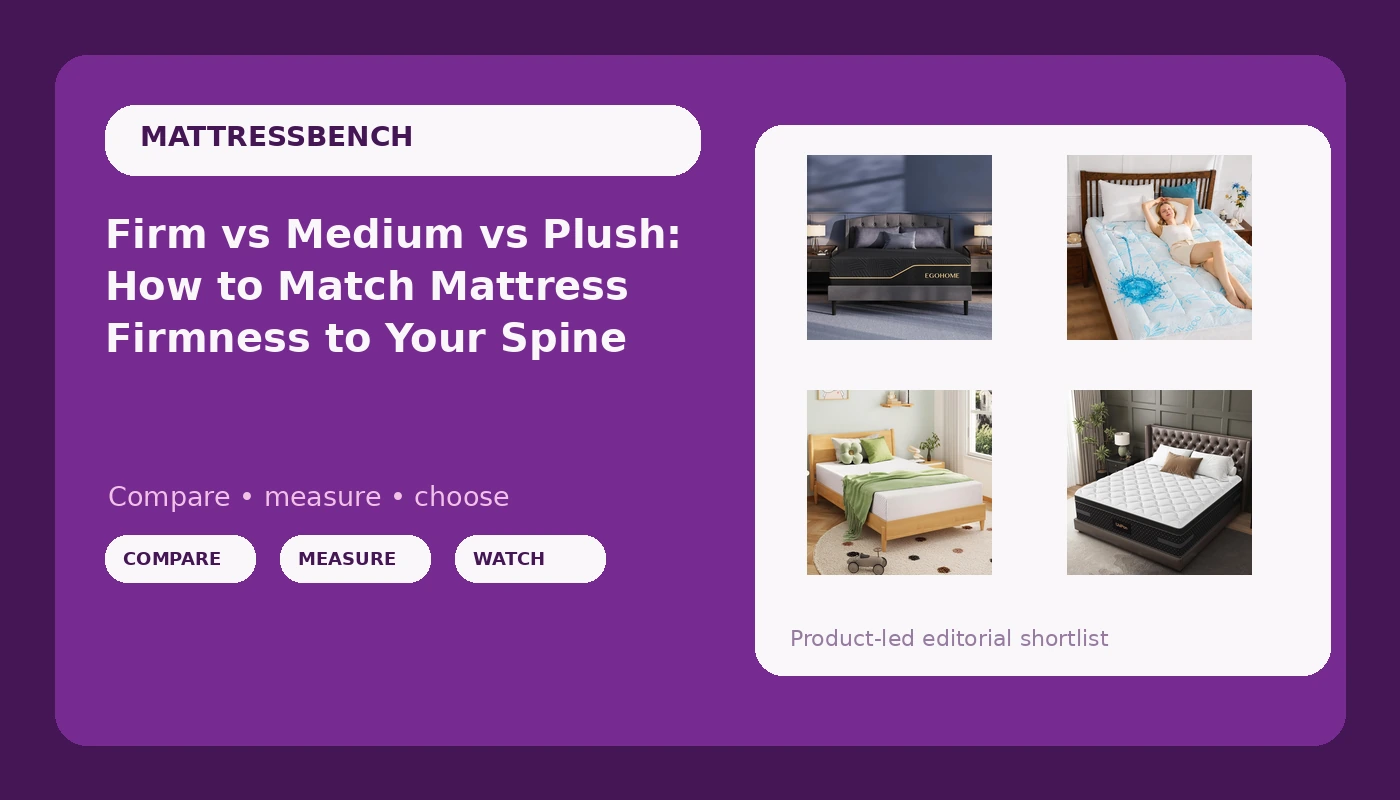
Most people shopping for a mattress are really asking one question: will this thing hold my spine or hurt it? Mattress firmness and support get used interchangeably in product listings, and that is exactly where the confusion starts. A mattress can feel rock hard under your hand and still let your hips drop an inch too far. It can feel plush and still keep your shoulders and hips level through the night. The four products below cover four different jobs in a bedroom: a queen hybrid positioned around back and lumbar support, a firm full-size hybrid, a waterproof cooling layer for hot sleepers, and a compact twin memory foam mattress. What follows is how to tell those jobs apart and how to decide which one your bedroom actually needs.
Related: How to Test a Mattress in 30 Nights →
Quick answer
Firmness describes how a mattress feels when you press into it. Support describes whether it keeps your spine in alignment while you sleep, and the two do not always travel together. Buy for support first, then use firmness to narrow the field within the mattresses that pass. If you sleep on your side, you generally want more give at the shoulder and hip. If you sleep on your back, you want a flatter surface that stops your hips from sinking. If you sleep on your stomach, you want the hips held up, not cradled. If the problem is heat rather than alignment, fix the surface layer before you replace the mattress underneath.
Four useful options
| Model | Best fit | What stands out |
|---|---|---|
| 12 Inch Medium Firm Mattress Queen, Hybrid with Back and Lumbar Hip Support | Sleepers who want one mattress to cover a shared bed | 12 inch hybrid construction in a queen size, positioned around back, lumbar, and hip support |
| EGOHOME Full Size 12 Inch Firm Hybrid Mattress | Sleepers who want a stiffer surface and a full-size footprint | Firm hybrid build with a 12 inch profile |
| Queen Size Waterproof Mattress Pad, Cooling Mattress Topper for Hot Sleeper | Hot sleepers and anyone protecting a mattress under warranty | Waterproof top layer combined with a cooling design |
| EGOHOME Twin Mattress 8 Inch, Green Tea Memory Foam Mattress, Medium Plush | Guest rooms, kids' rooms, and smaller frames | 8 inch green tea memory foam in a medium plush feel |
The all-around queen hybrid: 12 Inch Medium Firm Mattress Queen, Hybrid with Back and Lumbar Hip Support
This is the option to look at when two people share a bed and neither wants to argue about firmness. Medium firm is the compromise zone, and for a lot of back and combination sleepers it is the honest middle. The trade-off is that "medium firm" means whatever this brand says it means. It is a starting point, not a guarantee. If you are a strict side sleeper with wide shoulders, the same mattress that feels supportive to your partner can feel like pressure on your shoulder. If you are a strict back sleeper who wants the hips held level, it is more likely to work without a topper. Read the return policy before you commit, because the only way to know which camp you fall into is to sleep on it.
The firm full-size hybrid: EGOHOME Full Size 12 Inch Firm Hybrid Mattress
Firm is not automatically better for your back, and this is where most shopping advice goes wrong. Firm helps when the problem is a hip that sinks too deep and drags the lumbar spine out of line. Firm hurts when the problem is a shoulder or a hip that needs somewhere to go. The people who do well on a firm surface tend to be back sleepers and stomach sleepers, and lighter sleepers sometimes find a firm mattress harder than a heavier sleeper does on the identical bed. The trade-off with any firm hybrid is pressure. If you wake up with a numb arm, the surface is too hard for your sleep position, and a topper is a cheaper fix than a new mattress.
The cooling waterproof layer: Queen Size Waterproof Mattress Pad, Cooling Mattress Topper for Hot Sleeper
Cooling claims are the most oversold thing in the mattress industry, and a gel layer is not air conditioning. What a cooling pad can realistically do is change what touches your skin, and that matters more than most people expect. A waterproof layer also protects the mattress, which is not a small thing: stains are one of the most common reasons a warranty claim gets denied, and a mattress you keep clean is a mattress you keep longer. The trade-off is that adding a layer changes the feel of the bed. A thick pad can soften a firm mattress into something closer to medium, which is sometimes exactly what you want and sometimes not. If your mattress is already the right firmness, keep the pad thin.
The compact foam option: EGOHOME Twin Mattress 8 Inch, Green Tea Memory Foam Mattress, Medium Plush
This is the guest room, kids' room, and first-apartment category. A twin at 8 inches is thinner than a 12 inch hybrid, which means less material between you and the foundation, and that shows up first at the edges and over time in the middle. Medium plush memory foam hugs the body, which feels great for the first twenty minutes and can be the wrong answer for a stomach sleeper whose hips keep dropping. Memory foam also runs warmer than a hybrid with airflow through the core, so pair it with a cooling pad if the sleeper runs hot. For occasional use, none of that is a problem. For nightly use by an adult with back pain, a thicker, firmer build is usually the more durable choice.
Prices and availability may change. Product images, names, and retailer links are matched to verified listings. No current price, rating, stock status, or measured result is stated here without current evidence.
What the firmness label actually tells you
A firmness label describes initial feel, not overnight performance. It is written by the brand, tested by nobody in particular, and it is relative to that brand's own range. One company's medium is another company's firm. The label is a filter for narrowing a list, not a specification you can compare across listings.
Sleep position is the more useful filter. Side sleepers need somewhere for the shoulder to go and enough give at the hip that the pelvis does not get pushed up out of line. Back sleepers need a surface flat enough that the lower back is not left unsupported in the gap under the lumbar curve. Stomach sleepers need the hips held up so the lower back does not arch. Combination sleepers need a surface that does not punish them for changing position at 3 a.m., which usually means medium rather than either extreme.
Body weight matters as much as position. A 240 pound back sleeper and a 130 pound back sleeper will experience the same mattress differently, because the heavier sleeper compresses the comfort layers further. That is why reviews that say "too soft" and "too firm" about the same product can both be honest.
Why support and firmness are different measurements
Support is about alignment. The honest way to measure it is a pressure map, a sensor pad that shows where your body weight concentrates. If the map shows a deep well under the hips and almost nothing under the lumbar spine, the mattress is not supporting you no matter how firm it feels to your hand.
Edge support is the same question at the perimeter. Sit on the side of your bed tonight. If the edge collapses under you, the usable sleeping surface is narrower than the mattress dimensions suggest, and getting in and out gets harder every year. This matters more for couples, who effectively share the middle.
Foam density is the durability number that marketing tends to skip. Foam is sold by weight per cubic foot, and higher density foam holds its shape longer under repeated compression. Lower density foam feels fine in month one and loses height by year two, which is the sagging that makes a cheap mattress expensive. A mattress is a seven to ten year purchase. The one that sags in year two was never the cheaper option.
- Write down your sleep position and your rough body weight. Those two facts eliminate most of the field before you read a single listing.
- Measure the room and the foundation. A queen needs roughly five feet of width plus walking space, and a full size is a genuine option in smaller rooms.
- Decide whether you need a new mattress or a new layer. If alignment is fine and temperature or stains are the problem, a pad solves it for far less.
- Check how the mattress ships and how long you have to return it. A mattress in a box is easy to move and hard to judge in a showroom, so the trial window is your real test.
- Set a replacement date the day you buy. Seven to ten years is the working range for a quality mattress, and writing the date down prevents the decade of slow decline that people never notice.
How to test a mattress before the return window closes
- Sleep on it for at least thirty nights before you decide. The first week is your body adjusting to something new, not a verdict.
- Check alignment, not comfort, on the morning after. If you wake up stiff in the lower back, the surface is letting your hips drop.
- Sit on the edge and lean your weight forward. If the perimeter gives way, note it, because edge support rarely improves with age.
- Give an unboxed foam mattress the full expansion time listed before you judge the height or the feel.
- Use the foundation the manufacturer specifies. A slatted base with wide gaps or a soft box spring can undo the support a good mattress provides.
- If you run hot, change the surface layer first. A cooling pad is a smaller purchase than a new mattress and it addresses what you actually touch.
Which option should you choose?
Choose the 12 Inch Medium Firm Mattress Queen, Hybrid with Back and Lumbar Hip Support when you share a queen bed and want one firmness that covers back, side, and combination sleepers without going to either extreme. Choose the EGOHOME Full Size 12 Inch Firm Hybrid Mattress when you want a stiffer surface, you sleep mostly on your back or stomach, and a full size fits the room. Choose the Queen Size Waterproof Mattress Pad, Cooling Mattress Topper for Hot Sleeper when your alignment is fine but you sleep hot, or when you want to protect a mattress you plan to keep for years. Choose the EGOHOME Twin Mattress 8 Inch, Green Tea Memory Foam Mattress, Medium Plush when you need a smaller, softer mattress for a guest room, a kid's room, or occasional use.
None of these will cure back pain, and no mattress will. Firmness is personal; support is not. If you have persistent pain that follows you out of bed, that is a conversation with a clinician, not a shopping decision. What a mattress can do is stop being one of the reasons you wake up stiff.
The bottom line
Buy for support and let firmness break the tie. A medium firm hybrid is the safe middle for a shared queen bed, a firm hybrid is the right call for back and stomach sleepers who want a stiffer surface, a waterproof cooling pad is the cheapest way to fix heat and protect the mattress you already own, and a compact medium plush foam twin belongs in a guest room rather than under an adult with back pain. Whatever you pick, note the date you bought it. The number that decides whether a mattress was a good purchase is not on the listing. It is how it feels in year seven.